Network & Infrastructure
Canary to cloud: Building a flexible traffic strategy


Oscar Moreno Garza, Noah Crouch
Uber · Cloudflare
0:03Hey guys, my name is Enrique and I'm a product manager here at Cloudflare for private networks. Very excited to be here, day three. Over the past three days I learned so much about the cool things that you guys are doing. I'm really excited about to share the other cool things that we're doing as well. Today we're gonna be talking about private origins. So I don't know if you were in my earlier session about internal DNS, but that connects to this one. because how you get to private origins is using internal DNS. So let's get started.
0:37When we talk about private origins, we're talking about applications that live on private servers. Does these applications look familiar to you? We got SharePoint, we got admin dashboards. You've seen any of them internally. And they're private for a reason. We want to keep it that way. So what we're enabling with... Cloudflare Private Origins, it's, uh, so with internal DNS, you can find those applications. With Private Origins, you can protect the applications that you have internally. With the idea that you never share the IP address to the internet, everything is private, so you go through an on -ramp, either one tunnel, CNI, or any of those, where you can keep all of these, you know, applications private, but you get access to the cloud.
1:24services. Think about DDoS protection, think about WAF, think about everything that we do at the L7 or L4 level. Now private networks or private applications, they're not new, you know, they've been around for quite some time. The idea today, you have two ways to do it. You know, the first one is, you know, buying applications or buying appliances. So you have appliances that you run internally.
1:57Now, having that in place, it also means that you have to manage those applications. You get to patch those servers. You get to make sure that they're up and running. So it just adds more work to it. Then the second one is where you use a CDN to go out and back in to be able to support your private applications. Now, So think about an employee, you know, sitting in the same building as the application, but their request has to go through CDN and then comes back into their system. So it's just adding the extra path where you still have to have a private origin or a public origin in that case. Now, what I'm going to do today, I'm going to walk you through some use cases from our customers that are requesting to have a public host that ends on a private.
2:48network or a private service. So for example, Kaplan, their use case is that they have a public host name. They want to send things through Cloud4H where they have WAF, they have VAT, they got Caching. And then it ends on the private origin at AWS, which it has no public IP. So again, private origins allows you to have access to your private environment. without ever exposing your private IP. And then when you do that, you also get to have all the cloud cloud services in front of it. So if you want to do WAF, if you want to do bot, you can do that with our private connectivity. And I'll show you how that works in a second. But here's another example.
3:34SwissRE, their main goal is that they don't want to expose anything through the public internet. That means that they don't want to expose DNS at all. So the way we solve this is by using internal DNS and the use case goes through I don't want to expose my host but I still want to get to my private environment. So think about a private to private solution. So for them again without the public record they go to Cloud4H, they use a private address to get to their existing tunnel and eventually end up on their private origin. Next sample it's a main group. One of the things that they wanted to do is just to enable WAF, they wanted to enable access, they wanted to load balancing to their private origin.
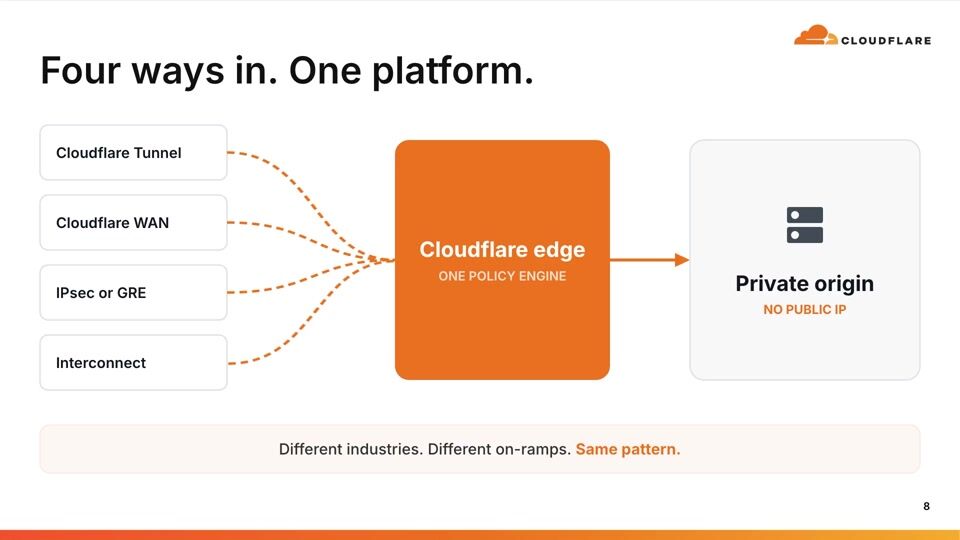
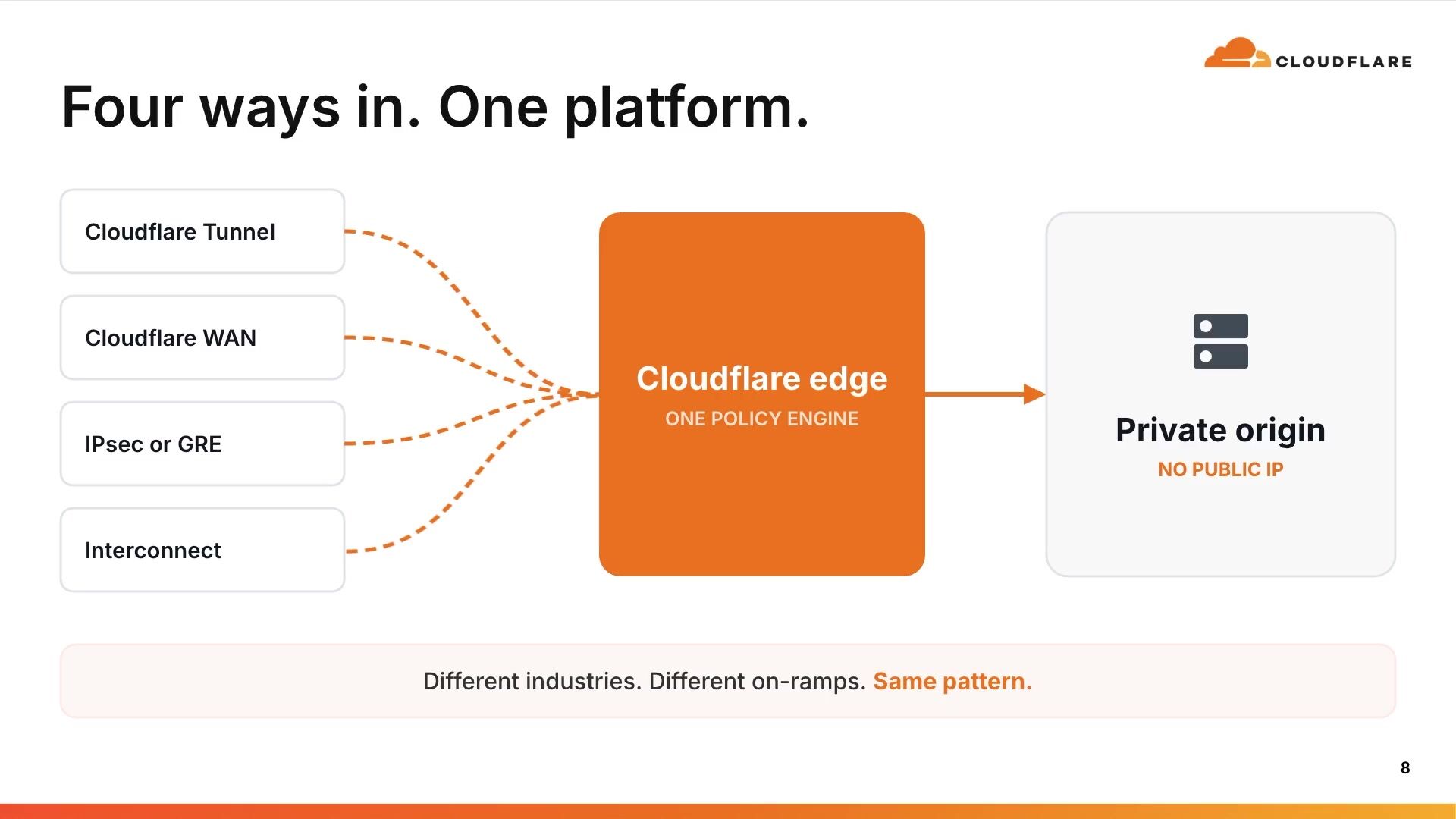
4:22Again, the way to get there is to use them private networks. They have a public host name, so someone on the internet can go to their website. We put in front of them WAF access, and then it goes through our existing tunnel and end up on their private origins. Again, so not exposed. any IP addresses from the servers, from the private audience, but adding the protection that Cloudflare provides at the L4 and L7 services. Now, there's four ways to get into a private origin through Cloudflare. So you can use Cloudflare Tunnel, you can use Cloudflare One, you can use IPsec or GRE, you can also use internet. And if you want, you can mix match depending on how your private connectivity works.
5:08With the idea that we route those through Cloudflare Edge, you know you have your policy engine, everything that you used to manage already if you have that in place, and then from there it'll end up in your private origin. Again, you'll hear me saying this multiple times, but the idea is that we don't want to expose any of your private origins. It goes through the Cloudflare private connectivity that you guys decide to put in place. So how does it work? and this is the part that I'm more excited about because it's literally one step you make a DNS change and then you're done obviously you have to have your private connectivity in place but once you do that so on the before side you can see how we're sending an app to a public IP address to a record so once you enable private network routing you send that to your private IP so that's the 10 .1, the 0 .1, and that private IP never gets exposed to the internet.
6:10Again, so everything works through the internal DNS. And then once you do that, then we can enable WAF, DDoS, back management, load balancing, any of the cloud services that we provide for your public audience as well. Now, I'm going to stop here and see if you guys have any questions, because this is the most exciting part of everything. You know, to make this work, you only have to do one DNS change everything striking out so far okay good all right so how does it work again so we never exposed the private IP and everything is all goes through our internal DNS and so on excuse me one second
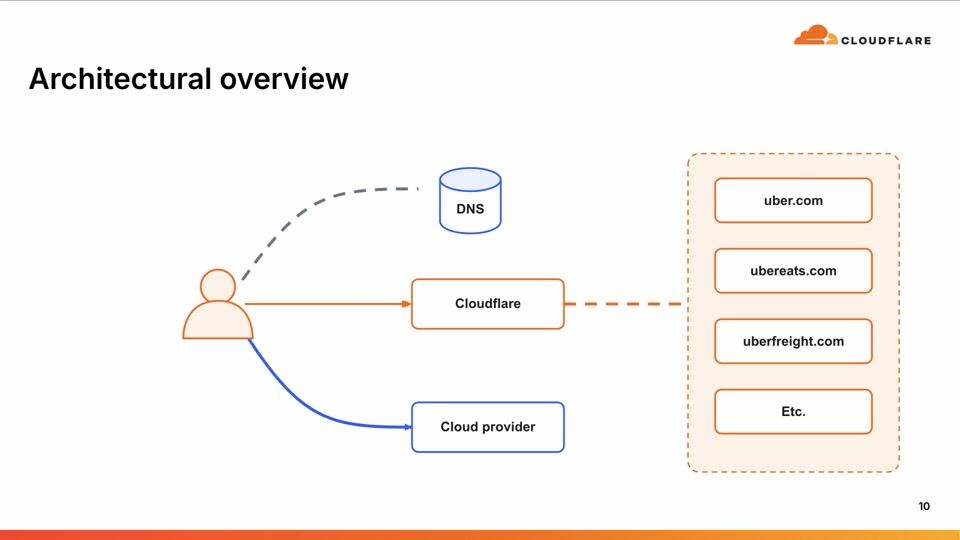
7:02So we're going to follow a request all the way through. So in this example, we're using app .example .com that's pointing to 10 .1 .0 .1 as the private origin address. So first, the user resolve to the public host name. Again, so in this case, it's the app.example.com. That host is still public, and this is our public to private use case. So whether they're North America, whether they're. any part of the U .S., you know, closer to the 340 data centers that Cloudflare has. Then from there, it'll go through the Cloudflare edge. So this is where we apply WAF, flat management, cache, all of the services that we provide for public audients. And then from there, it uses our private connectivity.
7:52Again, while it goes through a private connectivity, you never expose your private IP. range and again like i said earlier today you got you know four different ways to get to it cloudflare tunnel cloudflare one you know ipsec and network interconnect
8:09now so at cloudflare we've been changing how we see private origins and over the past you know few years uh we're changing our mind where we do not care where your origin is it can be in aws it can be anywhere in the world but the idea is that we want to offer the cloud -first services to you guys at the private origin without ever exposing that private IP. So as of today, we got public to private, where you have a public host name that ends on a private origin on your end that we're testing on beta. Good news is that we had about 46, 47 customers that tested out. So far, we got great feedback. to the point that it's going to go GA at the end of the month. We haven't announced this to anyone, but if you guys are ready to test it out, please reach out.
8:58We can get you into the beta, we can get you all the information to go GA. Now, as I was saying earlier today, Cloudflare is all about providing the services to protect your environments. We don't care what those environments are, so the next step is that we're going to go private to private. So just an example that I said earlier today. where we're never going to expose where the user comes from, it's going to go to your private connectivity and it's going to end up in your private origin where it's not going to get exposed anywhere. So think about going from one office to another office through the private connectivity without exposing or compromising everything, anything that you have in your network. And then eventually we're going to go into AI, workers, and all the other services that we have.
9:48So as... what's next so again so public to private that's gonna go GA at the end of the month we're really excited about it we want you guys to start using it private to private it's gonna go on alpha q4 so we're actively working on it to make sure that customers can get to having a private to private workflow and the way it's gonna work is we're gonna be using internal DNS again so you have a gateway to get to your query where you going to be well you're never going to expose you know where they're coming from where they're going to end and the idea is that you have access to again all the services that cloudfair provides uh all the different levels you know and seven of four when it comes into uh the needs that you have to protect your your your private origin so yes uh q4 we're gonna launch alpha uh q1 of 2027 looking to launch uh close beta and then eventually go GA by Q2 of next year.
10:50The goal is to get you to Cloudflare services without caring where the private origin is or any origin at all. Thank you.
Oscar Moreno Garza, Noah Crouch
Uber · Cloudflare
Tom Paseka
Cloudflare
Damiete King-Harry
Cloudflare
Be the first to know when registration opens and the agenda goes live.
---
title: "Cloudflare services for private origins: Today’s patterns and what’s next"
url: "https://www.cloudflare.com/connect/2026/session/cloudflare-services-for-private-origins-todays-patterns-and-whats-next"
year: 2026
---

# Cloudflare services for private origins: Today’s patterns and what’s next

[Watch session](https://www.cloudflare.com/connect/2026/session/cloudflare-services-for-private-origins-todays-patterns-and-whats-next)

## Session details

- **Track:** Network & Infrastructure
- **Topics:** App modernization, Network modernization & multicloud, Hybrid cloud
- **Solution areas:** Application Security, Application Performance, SASE & Workspace Security (Cloudflare One)

## About this session

Enterprises run critical applications on private origins: behind firewalls, in VPCs, and across hybrid clouds. These apps lack the same edge protection as their public-facing counterparts, so organizations maintain costly appliances like F5 BIG-IP or build complex hairpin architectures to compensate. Cloudflare application services for private networks extend Cloudflare’s WAF, DDoS, load balancing, and bot management to private origins — traffic reaches origins through Cloudflare Tunnel, Cloudflare WAN, IPsec, or Cloudflare Network Interconnect (CNI). This session walks through the patterns customers deploy today, real production examples, and the roadmap for unifying public and private application security.

## Speakers

- [Enrique Somoza](https://www.cloudflare.com/connect/speakers/2421461) — Product Manager, Cloudflare

## Transcript

[0:03] Hey guys, my name is Enrique and I'm a product manager here at Cloudflare for private networks. Very excited to be here, day three. Over the past three days I learned so much about the cool things that you guys are doing. I'm really excited about to share the other cool things that we're doing as well. Today we're gonna be talking about private origins. So I don't know if you were in my earlier session about internal DNS, but that connects to this one. because how you get to private origins is using internal DNS. So let's get started.

[0:37] When we talk about private origins, we're talking about applications that live on private servers. Does these applications look familiar to you? We got SharePoint, we got admin dashboards. You've seen any of them internally. And they're private for a reason. We want to keep it that way. So what we're enabling with... Cloudflare Private Origins, it's, uh, so with internal DNS, you can find those applications. With Private Origins, you can protect the applications that you have internally. With the idea that you never share the IP address to the internet, everything is private, so you go through an on -ramp, either one tunnel, CNI, or any of those, where you can keep all of these, you know, applications private, but you get access to the cloud.

[1:24] services. Think about DDoS protection, think about WAF, think about everything that we do at the L7 or L4 level. Now private networks or private applications, they're not new, you know, they've been around for quite some time. The idea today, you have two ways to do it. You know, the first one is, you know, buying applications or buying appliances. So you have appliances that you run internally.

[1:57] Now, having that in place, it also means that you have to manage those applications. You get to patch those servers. You get to make sure that they're up and running. So it just adds more work to it. Then the second one is where you use a CDN to go out and back in to be able to support your private applications. Now, So think about an employee, you know, sitting in the same building as the application, but their request has to go through CDN and then comes back into their system. So it's just adding the extra path where you still have to have a private origin or a public origin in that case. Now, what I'm going to do today, I'm going to walk you through some use cases from our customers that are requesting to have a public host that ends on a private.

[2:48] network or a private service. So for example, Kaplan, their use case is that they have a public host name. They want to send things through Cloud4H where they have WAF, they have VAT, they got Caching. And then it ends on the private origin at AWS, which it has no public IP. So again, private origins allows you to have access to your private environment. without ever exposing your private IP. And then when you do that, you also get to have all the cloud cloud services in front of it. So if you want to do WAF, if you want to do bot, you can do that with our private connectivity. And I'll show you how that works in a second. But here's another example.

[3:34] SwissRE, their main goal is that they don't want to expose anything through the public internet. That means that they don't want to expose DNS at all. So the way we solve this is by using internal DNS and the use case goes through I don't want to expose my host but I still want to get to my private environment. So think about a private to private solution. So for them again without the public record they go to Cloud4H, they use a private address to get to their existing tunnel and eventually end up on their private origin. Next sample it's a main group. One of the things that they wanted to do is just to enable WAF, they wanted to enable access, they wanted to load balancing to their private origin.

[4:22] Again, the way to get there is to use them private networks. They have a public host name, so someone on the internet can go to their website. We put in front of them WAF access, and then it goes through our existing tunnel and end up on their private origins. Again, so not exposed. any IP addresses from the servers, from the private audience, but adding the protection that Cloudflare provides at the L4 and L7 services. Now, there's four ways to get into a private origin through Cloudflare. So you can use Cloudflare Tunnel, you can use Cloudflare One, you can use IPsec or GRE, you can also use internet. And if you want, you can mix match depending on how your private connectivity works.

[5:08] With the idea that we route those through Cloudflare Edge, you know you have your policy engine, everything that you used to manage already if you have that in place, and then from there it'll end up in your private origin. Again, you'll hear me saying this multiple times, but the idea is that we don't want to expose any of your private origins. It goes through the Cloudflare private connectivity that you guys decide to put in place. So how does it work? and this is the part that I'm more excited about because it's literally one step you make a DNS change and then you're done obviously you have to have your private connectivity in place but once you do that so on the before side you can see how we're sending an app to a public IP address to a record so once you enable private network routing you send that to your private IP so that's the 10 .1, the 0 .1, and that private IP never gets exposed to the internet.

[6:10] Again, so everything works through the internal DNS. And then once you do that, then we can enable WAF, DDoS, back management, load balancing, any of the cloud services that we provide for your public audience as well. Now, I'm going to stop here and see if you guys have any questions, because this is the most exciting part of everything. You know, to make this work, you only have to do one DNS change everything striking out so far okay good all right so how does it work again so we never exposed the private IP and everything is all goes through our internal DNS and so on excuse me one second

[7:02] So we're going to follow a request all the way through. So in this example, we're using app .example .com that's pointing to 10 .1 .0 .1 as the private origin address. So first, the user resolve to the public host name. Again, so in this case, it's the app.example.com. That host is still public, and this is our public to private use case. So whether they're North America, whether they're. any part of the U .S., you know, closer to the 340 data centers that Cloudflare has. Then from there, it'll go through the Cloudflare edge. So this is where we apply WAF, flat management, cache, all of the services that we provide for public audients. And then from there, it uses our private connectivity.

[7:52] Again, while it goes through a private connectivity, you never expose your private IP. range and again like i said earlier today you got you know four different ways to get to it cloudflare tunnel cloudflare one you know ipsec and network interconnect

[8:09] now so at cloudflare we've been changing how we see private origins and over the past you know few years uh we're changing our mind where we do not care where your origin is it can be in aws it can be anywhere in the world but the idea is that we want to offer the cloud -first services to you guys at the private origin without ever exposing that private IP. So as of today, we got public to private, where you have a public host name that ends on a private origin on your end that we're testing on beta. Good news is that we had about 46, 47 customers that tested out. So far, we got great feedback. to the point that it's going to go GA at the end of the month. We haven't announced this to anyone, but if you guys are ready to test it out, please reach out.

[8:58] We can get you into the beta, we can get you all the information to go GA. Now, as I was saying earlier today, Cloudflare is all about providing the services to protect your environments. We don't care what those environments are, so the next step is that we're going to go private to private. So just an example that I said earlier today. where we're never going to expose where the user comes from, it's going to go to your private connectivity and it's going to end up in your private origin where it's not going to get exposed anywhere. So think about going from one office to another office through the private connectivity without exposing or compromising everything, anything that you have in your network. And then eventually we're going to go into AI, workers, and all the other services that we have.

[9:48] So as... what's next so again so public to private that's gonna go GA at the end of the month we're really excited about it we want you guys to start using it private to private it's gonna go on alpha q4 so we're actively working on it to make sure that customers can get to having a private to private workflow and the way it's gonna work is we're gonna be using internal DNS again so you have a gateway to get to your query where you going to be well you're never going to expose you know where they're coming from where they're going to end and the idea is that you have access to again all the services that cloudfair provides uh all the different levels you know and seven of four when it comes into uh the needs that you have to protect your your your private origin so yes uh q4 we're gonna launch alpha uh q1 of 2027 looking to launch uh close beta and then eventually go GA by Q2 of next year.

[10:50] The goal is to get you to Cloudflare services without caring where the private origin is or any origin at all. Thank you.

## Related sessions

- [Canary to cloud: Building a flexible traffic strategy](https://www.cloudflare.com/connect/2026/session/canary-to-cloud-building-a-flexible-traffic-strategy)
- [How the Internet really works: Into the depths of Internet infrastructure](https://www.cloudflare.com/connect/2026/session/how-the-internet-really-works-into-the-depths-of-internet-infrastructure)
- [6 architecture patterns that repeat across enterprise customers](https://www.cloudflare.com/connect/2026/session/6-architecture-patterns-that-repeat-across-enterprise-customers)

## More from Connect

- [All sessions](https://www.cloudflare.com/connect/)
- [Get notified for Connect 2027](https://www.cloudflare.com/connect#2027)

