Security & Compliance
Building Argus: AI & ML threat detection at scale in Cloudflare

Henry Montagu
Cloudflare
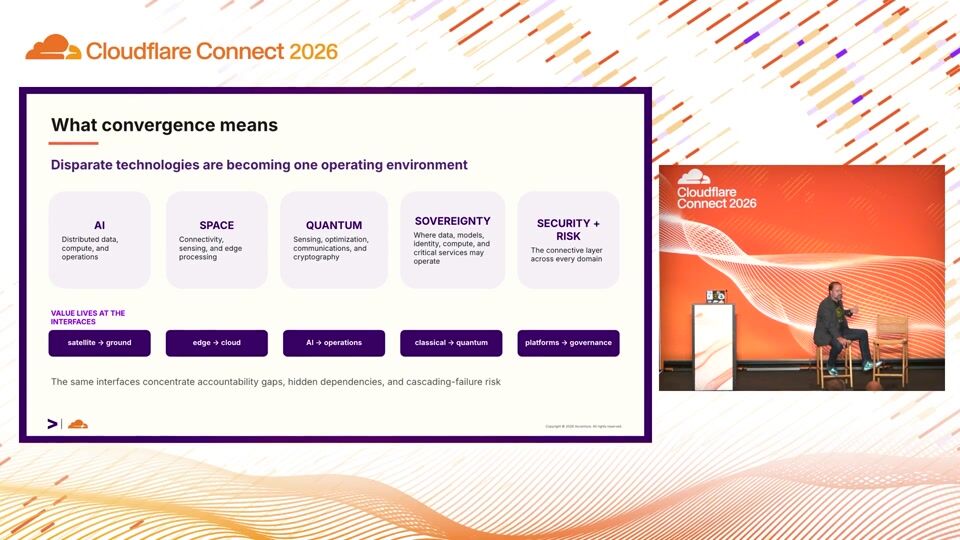
The leading-edge technologies of today (and tomorrow) aren’t just capabilities in their own right but force amplifiers for other use cases, both good and bad. Every new capability carries within it a new risk, and when you point amplifying technologies at each other, you can end up with unpredictable and exponential outcomes. Come hear how we can collectively employ second-order thinking in the creation of guardrails against future risk and think more broadly about not just what’s possible but how to be ready when it goes wrong. This session is sponsored by Accenture.
0:03so intros i run uh emerging tech security business development for accenture i spend a lot of my time thinking about what's next helping people think about how to be prepared for what's next thinking about what kinds of interesting things happen where domains overlap with each other
0:21um right now that's a lot of things around quantum and space and you know subsea communications and, you know, advanced robotics and AI, there's a lot of intersection of many of these topics. And like a lot of things in emerging tech, one of the defining features of all this stuff is that it is evolving. So a lot of the capabilities are not thoroughly understood. Many of them are still in the process of appearing. And as usual, the security implications of new capabilities they follow you know a year two years three years five years sometimes after when capabilities arise so for defenders and people that need to think about risk and how to safely adopt new stuff it can be especially challenging when you're dealing with emerging tech because the domain that you're trying to secure is not fully understood yet so that's kind of what this is about um this talk has evolved significantly in fact i have a whole new page worth of stuff that came out of a conversation i had yesterday afternoon with uh wesley evans from cloudflare so if he shows up here i'm probably gonna call on him but this is what it looks like um this talk is not about how to think about a particular technology this is not about how to
1:52your organization's specific risks and this is not about what to invest in next if I knew that I would not be up here I would be on a beach somewhere what this talk is is how to build a robust framework for thinking about and deciding and acting in a world where everything is getting faster exponentially all the time it's not just that things are getting faster is that rate at which things are changing is itself accelerating. So we're going to talk about how to navigate a pace of change that almost by definition is growing faster than our capacity to deal with it. So this talk is titled Convergence.
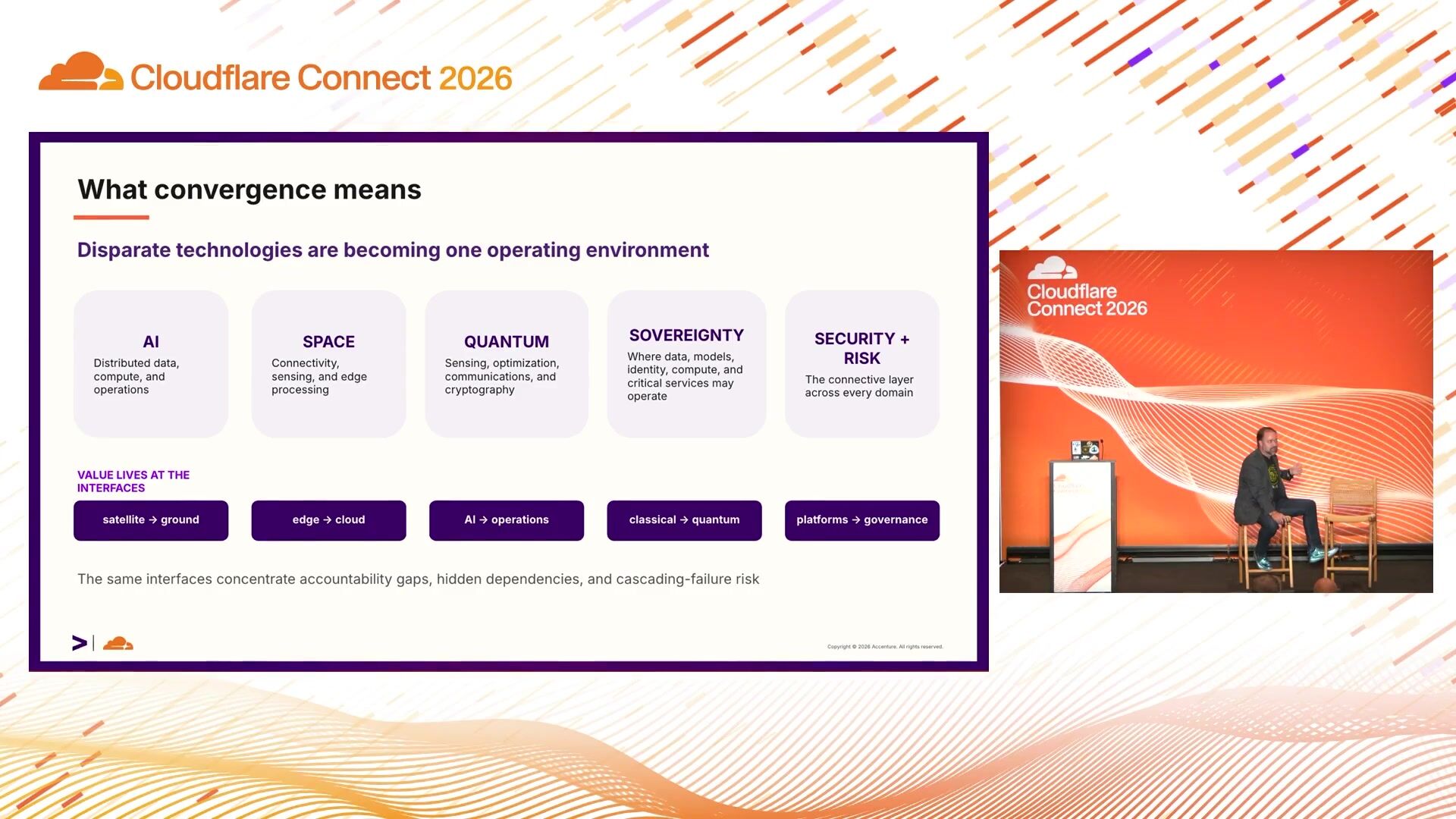
2:40I've been thinking about this for a couple of years now, and I want to first talk about what that is. So if you look in American webster .com you will see that convergence is you know if you're talking about math it's uh the property or manner of approaching a limit um if you're talking about biology it's how similar but unrelated structures can have a common kind of evolution that's guided by environmental factors it can also be and for the purpose of this talk this is about the merging of distinct and disparate or industries or devices into a unified whole that operates as a as a unit. And I have added that this is the increasing tendency of technologies and social structures to interfere with and reinforce each other in unpredictable ways.
3:36I'm looking up here because my my slides are not showing up on the thing in front of me, so you and I are gonna be looking at the same thing.
3:44Convergence is about a bunch of disparate technologies that affect each other and the rate at which they affect each other is accelerating so that they eventually quit being distinct technologies and become one technology. So if we think about, you know, artificial intelligence, for instance, prior to say 10 years ago, AI was its own separate discipline and the people who were researchers and worked on it pretty much stayed in their lane. Now, AI is... it's in everything it's like you know the guys that sell cranberry juice at ocean spray it's in every fruit so ai is in everything it impacts everything it changes the calculus on how we do everything and what's possible it also changes the risk calculus on what we need to deal with those of you who are plugged in may have seen any number of the significant security stories that yesterday you know php and certificate authorities and other stuff um the rate at which these things are discovered and the rate at which they are exploited and leveraged is only going to increase and this has a lot of implications for the way that you know security and operations folks and developers and people in business and risk that they all do their jobs um like i said i also spent a lot of time thinking about space and quantum.
5:08Space is particularly interesting because, again, that's another one that was its own domain for a long time, and now it's becoming an enabler for a whole bunch of other different things, many of which don't have anything to do with space. We're fond of saying in my practice that every company is a space company. Many of them just don't know it yet. For instance, I found out a few weeks ago that something like 20% of the foods supply chain in the U.S. is directly dependent on objects in space. And if we lost GPS or geospatial imaging or hyperspectral cameras that can, you know, monitor drought levels, if any of those things went away, we would have an immediate drop in food supply for the U.S.
5:56And it works that way around the world. Quantum, you know, everybody knows about that. People in security are primarily thinking about, when is RSA going to fall or ECC but there's a lot of other aspects to quantum technologies beyond just the computing and the cryptography and again the overlap of quantum and space is really interesting because there's a lot of governments and startups that are working on quantum based technologies that are alternatives to the GPS system you may have noticed different places in the world where it's particularly difficult to navigate because GPS can be spoofed, GPS can be jammed. It turns out quantum technologies that measure the gravitational force of the surface of the Earth or other kinds of quantum behaviors are resistant to those kinds of attacks.
6:51And so there's a lot of money and a lot of interest that is pouring into these alternative approaches that are based on this emerging tech. Sovereignty, which... uh i'm sure you guys heard about on the main stage this morning talked about it yesterday um i think this is going to be the number one most underreported and significant factor in all of technology for the next decade probably even more important than ai because sovereignty is going to determine how people build what they build it's going to determine how they architect it and it's causing a lot of organizations and governments to rethink assumptions that have been in place for about 20 years now about suppliers and about trusted partners and who they can rely on and what resilience looks like.
7:43All of these things are being called into question and governments are able to make assertions that their, you know, companies have to abide by and that includes things about where your data lives of but also things like if you want to operate in our borders, you have to use our sovereign cryptography libraries. We're seeing that already in places like South Korea, United Arab Emirates, that people are not just taking the NIST standards and applying them. They're saying we're going to invent our own stuff from first principles because we want something that we own. And then security and risk is kind of the common story across all this stuff. You know, I wear the security hat. but my career has been primarily in operations and architecture and running stuff and building stuff, and so I'm always thinking about how can something fail and what happens when it does fail.
8:37And so the value but also the complexity lives where all these things intersect with each other, where satellites intersect with ground stations and where ground stations intersect with the rest of the Internet, where the edge, you know, Cloudflare's regionless architecture where you have to backhaul that to an AWS or an Azure GCP region in order to do complicated processing, there's complexity there. Same thing when it comes to AI and operations. We've talked about that at length. So these same interfaces, they add complexity, and complexity is the enemy of security. It's the enemy of resilience because it hides risk. It makes it difficult to see. and especially it creates hidden dependencies. So convergence is a systemic behavior.
9:27It's not any single individual component. It is the consequence of the way that components in the system interact with each other. So all the interesting stuff happens at the point of overlap, but that's also where we find exponential behavior and things that are unpredictable. So talk for a minute about technology as force amplifier and let me also say that I apparently am missing all the rest of my uh all the rest of my section dividers. This is going to look like a really long section but this is actually supposed to be like three or four sections. I may have a Q&A at the end so if you've got something you want to ask about or talk about keep it in mind.
10:13Amplifying technologies, these are things that multiply what you can already do. It multiplies a capability, it multiplies a constraint, it multiplies an intent. That bit at the bottom is important. Technology is an amplifier of human activity. Whether you are delivering medicine, whether you're delivering weapons, whether you're an activist or a repressive government, technology gives you greater reach, greater scale, more effective action. The power of technology is not restricted to any particular... content, it is effective across the board. So we need to be thinking about that as we're building technology, and I'm going to get into that a little bit later in this deck. The upside, talk about AI, it makes everything run faster.
11:00But that's, as we're going to see in a minute, that's not always a benefit. Space adds reach and sensing and visibility, and in particular, ubiquitous and highly consistent constant connectivity around the world, which has a lot of societal implications I'm going to talk about. Quantum, it strengthens sensing. And timing, we're seeing significant advances in timing technology that are enabling much more powerful and consistent distributed computing models because we have a level of granularity that's better than what we can get from GPS and CC of atomic clocks. All these things, you know, create risks though. Once we start depending on something, you know, the obvious risk is, well, what if that thing goes away or it fails?
11:45Now I've got something I'm depending on, now I've got a problem if it goes away where, you know, last year I wasn't depending on, I didn't care if it went away. So AI scales things, it also scales deception. If you make a bad decision, you can make a bad decision a whole lot faster with AI than you can if you're trying to write stuff out manually. Same thing with distributed connectivity. You know, it used to be if somebody wanted to attack your web server, there was a particular box and a particular colo center that your website ran on and they had to hit that box. Now, you've got an attack service that covers the whole world. And there's a lot of dependencies in that, too. It's much more complicated to run a service today than it was, you know, 25 or 30 years ago when I got started.
12:32There's much more capability, but there's much more complexity that goes with that. When we talk about space... That is a boss -level OT infrastructure challenge. Once you get stuff up there, recovery is almost impossible. Software patching is extremely difficult, if it's even possible at all. So we have a lot of assets that run in space that have been up there for 20, 30 years that are wide open from a security perspective. Because when they were launched, the security was the only address. that could touch it would be Russia, and we knew what their capabilities were. Now, anybody with $800 worth of software to find radios off of Amazon can intercept signals from any of the geosynchronous satellites and pull down unencrypted military text messages.
13:22There was a whole thing on Wired about that last year.
13:26And anybody who has been paying attention to Quantum knows that Q-Day is coming. I missed Sharon's talk about that yesterday, but.
13:34IBM and IonQ and Google at least think that we will have a cryptographically relevant or Amazon calls it a commercially relevant quantum computer by 2029. We'll see. It's certainly sooner than it was 18 months ago. We're seeing both an increase in the
13:58effectiveness of attack algorithms and well that brings the ceiling down and we're also seeing the floor raised by improvements in quantum computing capability and coherence times and error correction in particular from all the quantum companies so as those two things come together that's when we're going to see probably ECC first and then RSA become very vulnerable to attackers
14:28so technology The wheel made it possible to carry more than your muscles could handle. The lever made it possible to build the pyramids. The bow made it possible to hit somebody that was further away than the reach of your arms. But technology can also amplify other technology. It doesn't just amplify what humans do. You can point it at itself, and that's when things start to get weird. The computer amplified human calculation. That's ENIAC up there. And... then amplified everything else that humans can do, including designing and creating new computers. That's when you start to get these interesting feedback loops that are constantly accelerating. I think artificial intelligence is poised to do for software what early computers did for hardware.
15:16They're going to amplify the impact and capability of the systems that they run on, reinventing themselves as they go in this feedback loop that has very unpredictable outcomes. So the tech amplification of your effort is linear, but tech amplification of other tech is exponential. So in this conversation, we have accelerants and we have complicating factors. So the accelerants, AI, everything goes faster, like we said earlier, but that's not always a benefit. Shorter iterative cycles mean that you have less time to about the impact of what you're doing you have less time to be aware of risks or second order effects or downstream implications um it means that you're running at a faster pace and those of you with a you know military background probably recognize the OODA loop um observe orient decide act unless i got the first two o's backwards what we end up with is OOD all become compressed and action is faster and faster and faster and so you have less time to be aware of your surroundings to consider the implication of the decisions that you're making and to attempt to be prepared for whatever the next iteration is going to be and so you end up chasing change rather than leading change.
16:44For quantum We talked about it already. It's novel and faster approaches to a lot of longstanding challenges in security, but also in computing. You can already go rent time today on a quantum optimization machine and solve some real -world problems. Now, most of that stuff is currently constrained to certain kinds of quantum optimization problems that are relevant to scientific research. we're starting to see more real -world capability around material science and I think other kinds of optimization problems including logistics are going to be coming soon behind over the next couple years so it's not just cryptography and like we said earlier it's also not just compute there's quantum sensing and other kinds of quantum technologies that we can use to protect security of communications different points we don't have to rely exclusively on cryptography which is constantly evolving but quantum has common math underpinnings to AI they both overlap a lot on the kinds of algebraic activity that defines how they work so my expectation is that as quantum compute and AI become more advanced and start to overlap with each other we're going to have some surprises that derive in part from the fact that they share some math.
18:14Space is really interesting especially the last six months because there's been a lot of press about AI data centers in space and maybe eventually there are some fundamental physics problems that need to be solved around energy density of solar and cooling in particular is surprisingly difficult in space but if we can tackle those things and I've got a reading link for you in the appendix about that that could potentially remove two of the biggest constraints on the growth of compute on the ground. But then that leads to the question of is unconstrained growth of compute a good thing?
19:00Is it a bad thing? What are the side effects to society of removing some of these natural constraints that we've always had to live with and design an architect around? So, important to keep in mind here, every new capability brings a new risk. As you implement something, the implementation of that thing brings a risk beyond just the simplistic, what happens if now that I depend on it, it goes away? As we implement new technologies, they interface with existing technologies and capabilities, and they create new kinds of dependencies and new kinds of multi -tiered failure modes. And the newer the technology... is the harder it is to understand and predict what those downstream risks are going to be. I really like Paul Verlio's quote here that when you invent the ship, you invent the shipwreck.
19:48So let's talk for a minute. I actually think these two are backwards, so I'm going to go here and then I'm going to go back. So we talked about accelerants. Now let's talk about complicating factors. Sovereignty. I mentioned that I think that's going to be the biggest
20:07the biggest underlining tech story of the next decade that's going to decide how things are architected and implemented. I know for sure that it is driving things like Cloudflare's new DRA for distributed control plane. It's specifically because of sovereignty concerns where it's not enough to just have my data resident within my borders. I need to guarantee that my control plane is also resident within my borders. So I think we are not nearly at the end of those conversations, but they have significant implications for decision-making. And all of this stuff is what I would term a non -functional requirement. For those of you who are developers, these are things that somebody is going to impose from outside.
20:53They don't have anything to do with how you build your stuff necessarily, but they are parts of your calculus that you have to take into account. um externalities and abstractions i think this is particularly interesting we start talking about ai so this was part of the conversation i had and i'm very indebted in particular to uh wesley evans and trey guinn from cloudflare they've talked to me a lot about this last year or two um ai is a really interesting use case here because what we're hearing from the clients that we talk to is that many of them especially in non -tech industries, are interested in AI, but it's not going to be a binary yes -no.
21:41Many of them are trying to figure out, if we support this, what's our policy going to be? How much are we going to support? If I'm an insurance company, do I allow somebody's muse to order life insurance policy? Do I allow them to call a tow truck for road? assistance. You know, what are the failure modes of these things? What happens if somebody makes a mistake? Who owns the liability on it? The liability discussion will be super interesting, not just for AI, but also for space, and I'll get to that in a minute. So as we start to see more agents acting on behalf of humans, being able to disambiguate when a human is actually doing something themselves and when an AI is acting on their behalf with potentially a human is actually you know in programming we've long had the uh problem of do what i say and do what i mean are not the same thing and i think we're going to see that a lot with ai where ai is going to do what you say mostly or what it thinks that you said but that may not at all be what you meant and even what you mean might not take into account some of those second order effects and downstream risks so like i said earlier Security and risk mean more points of intersection, more complexity, more tax surface, more dependency The dependency chains are extremely complicated right now.
23:05If you are working in an organization around cryptographic readiness or quantum transition, like adoption of new cryptography standards, that is an enormous change management problem. And most of what you have to do is not even under your direct control. It comes from a supplier who depends on another supplier. and they're dependent on Microsoft and there's a lot of complexity there that has to be navigated all that complexity means there's a whole lot more ways for things to go wrong and that means more surprises so as you're thinking about all this stuff two rules to keep in mind number one make it as simple as possible i think complexity is the single biggest cost in most organizations it is hard to quantify it doesn't show up on a balance sheet it is difficult to get funding to attack that stuff, but over time, complexity will cost you more as an org than probably any other single factor.
23:57And then rule three, everything is a trade -off.
24:06So I said I'd go backwards a little bit, talk about sovereignty specifically. I'm particularly interested in some of these sovereignty questions when it comes to space. So as... compute becomes a thing, whether it's orbital compute on constellations, I mean maybe AI data center training eventually, but I think initially compute in space is going to reflect the constraints of the environment. It's already there and we're actively working on creating compute capabilities that are going to support what people already need to do in space, whether it is the construction of the newcomers. space stations are going to replace the ISS, NASA dropped the RFP for that a couple of weeks ago, or whether it is figuring out how to navigate the complexity of I'm a robot on the moon and I found something interesting in a crater on the south pole and I need to get this info to earth and I got to bounce off of a cell tower and a lunar orbit and then I got to bounce off geosynchronous and then maybe low earth orbit and then I got to go down to a ground station and all hops are operated by different entities that need to be able to talk to each other and meter their access like there's a lot of complexity involved here and for highly regulated entities if you're trying to do space or manage transactions or payments in space figuring out which
25:37jurisdiction applies or whether or not your data is still even considered to be compliant with sovereign restrictions if it operates in space. I mean, if it's orbiting the earth every 90 minutes, is it really within my country's borders? Most of what's happened in space the last 50 or 60 years has been primarily scientific research and a lot of cross -governmental coordination and collaboration. Even during the height of the Cold War, we still agreed on some stuff around space. The International Space Station has been a great example of how even countries that are not friendly towards each other can still cooperate when it comes to doing things together in space.
26:23It looks a lot like what we do in Antarctica, but as we see commercial operators coming into the picture, the incentives are now less about research and discovery and cooperation and more about commercial advantage and being a first. So, excuse me, I think as that evolves, a lot of these latent risks that we have been able to avoid by only having a very small handful of players are going to become active risks as we try and figure out how to deal with the complexity of an environment that has lots of different players with lots of different incentives and many of which are directly competing with each other.
27:09So, like I said earlier, sovereignty changes the shape of what we're building. It places non -technical, non -functional requirements on what we do so that we're no longer building things based solely on cost efficiency or performance or resilience. We now have external factors that are part of our calculus that constrain how we can Now, I want us to do a little sidebar for a second. and talk about connective tissue um those of you in operations would probably recognize this that you can have all the capability in the world but if you don't have a way to put it into action or connect a capability to another capability then it's power but it doesn't have any kind of direction and it can't do anything useful so muscles need tendons in order to be useful and that means that these capabilities that we're building like you know in the world the new frontier language models come out really powerful what can you actually do with it that's practical is enabled and constrained in part by a lot of these other much less exciting components like standards and governance and you know network connectivity and identity like all these things are needed in order to actually make the exciting new capability something that is useful you So this is a section where we're going to talk about exponential change.
28:38I touched on it before. The next wave is not going to be one breakthrough. It's not going to be just AI. It's not going to be just a quantum computer. It's not going to be just, you know, a space-based orbital compute platform. It's going to be a consequence of how these things reinforce each other. And we're seeing that already where, you know, AI is... helping to develop AI. AI is being used to improve quantum circuit design and as quantum computers become more capable We're using quantum computers to do optimizations for AI neural networks that are not Possible within a reasonable timeframe on a classical system. So these things are overlapping and reinforcing each other and you end up with these nonlinear outcomes Second-order thinking is really important here and i got a great reference in the appendix on this that you should absolutely read but we need to ask questions like what dependency does this new capability create what becomes a systemic point of failure if i create this capability who's excluded now or who's newly empowered what happens when this capability becomes cheap ubiquitous autonomous what happens if it's contested what do those changes then So we need to think not just about what is possible, or what can we do with the thing that we're building, but what is the implication of the existence of that thing to the way that other stuff operates.
30:11I mentioned at the top about societal changes.
30:18I'm particularly interested in the development of ubiquitous connectivity through low earth orbit Starlink and Amazon Leo and some others China's got one that's launching a lot of the history of technology has been defined by geographic proximity to Silicon Valley if you are here where the people are and you have access to capital and access to really high quality internet connectivity it gives you the capability to do things that you couldn't do if you were in Lagos or if you were in Sydney or if you were in, you know, Ho Chi Minh City or something. But as internet connectivity becomes consistent, if you can get the same 50 millisecond ping anywhere in the world for the same price anywhere in the world, there's not nearly as much geographic privilege to being in San Francisco or next door to U .S.
31:14East 1 or, you know, in Munich or London or any other. major tech hub. And that means that a lot of the, so those of you that saw, uh, yesterday afternoon's, uh, presentation from Bill Gross, super interesting because all of these business ideas, the place that we're seeing in the world, the most explosion of entrepreneurship and creativity, it's Africa. But Africa has traditionally been restricted on capital. They've been restricted on capital. connectivity. So capital is kind of a different problem, but a lot of these things have reliable connectivity as a prerequisite. So when that's no longer a problem, it unlocks a lot of capabilities and those capabilities have very significant societal impacts downstream.
32:07When more people can start more businesses, you've got more jobs, you've got more capital coming in, and that becomes a virtuous cycle. it tends to have a very democratizing effect. On the flip side, sovereignty, that can replace external dependencies like running stuff on AWS or Azure or even Cloudflare with a requirement for in -country capabilities. But many countries don't have the technical capability or the talent in -country to do a lot of these emerging tech kinds of things. So Even if they have a requirement to do it in -country, they may not have the ability to deliver on that yet.
32:53So, I mean, that can, depending on who you ask, can be a good thing in that it makes national policy less dependent on external political factors. But, like I said at the top, technology is an amplifier whether you're a good guy or a bad guy. So, if you're a repressive government, it also... that you now have much more capability to operate outside of the influence of external countries and providers. As societies change and evolve, they assimilate new technology more quickly. As you assimilate new technology, it grows your capacity to assimilate new technology, and so you end up with this exponential feedback loop that is occurring.
33:41Characteristic of a modern world. So I would say here that change is inevitable But it does not have to control us. We can control our pace of adoption. We can control how we respond to it When you point an amplifier to an amplifier you accelerate the creation of technology Then that accelerates the society that operates the technology
34:07Many of you probably familiar with EO Wilson's quote here. I love it, so I reproduced it. The real problem of humanity is that we have Paleolithic emotions, medieval institutions, and godlike technology. And I'm not sure how much I agree that we are approaching a point of crisis, but this guy was an expert on this, and he studied it for a long time. So we're now at the last bit of this talk, which is how do I receive bond to all of this how do i think about it how do i deal with it and then i'll have some time for q a so think long term when you're knocking and i really wanted to get a uh animation here but i couldn't find one and then it wouldn't have been uh it wouldn't have been fair use anyway but if you think about those people that have the world record for the biggest domino stuff and they push it and does all this crazy artwork that first domino that they knock over doesn't show you anything about what the final picture is going to look like.
35:05So you have to think beyond what is the first thing that I'm doing to what is that going to hit and then what's that going to hit and then what's that going to hit. So second order effects are really critical considerations. The biggest impacts of a technology are not usually visible from the onset of the tech and they're not usually immediate. If you think about Kessler syndrome in orbit that's That's when, for those of you that have seen WALL -E, that cloud of debris around the Earth, that's what the output of Kessler syndrome is. That's when you have objects that collide in orbit and they create a whole bunch of debris and each one of those pieces of debris increases the chance of another collision and you end up with this escalating chain and the outcome is orbit is completely unavailable.
35:58You can't put anything up there because it's just going to get hit by something else. And this is a very serious problem that governments around the world are working on right now. But that's very much downstream from the way that we've been managing space the last 30 or 40 years. People throw stuff up there and they leave it and eventually the orbit decays or maybe it doesn't.
36:22Secondly, don't target a technology. Create a capacity for change. That's really important specifically around my practice. day job which is quantum readiness and cryptographic transition. You can see that list of acronyms there. It's the evolution of cryptographic standards the last 25 years. Each of those things when they came out was considered to be the best that we had. It was absolutely new and cutting -edge and it was it was considered to be great. Each of them got replaced by something else because later on we found holes in the implementation. We found holes in the math. Whatever it is that you're adopting today will be replaced. Nothing that you are doing today is going to stick around forever. It's all going to get replaced.
37:09So the only way to keep up with that is to get good at change. It's not enough to implement whatever is on your plate or in your pipeline today. You need to get good at the practice of making changes.
37:27I had a slide somewhere that had three questions on what we should do the fourth question is what am I giving up if I choose to do this thing this opportunity cost is probably the second biggest cost in most orgs next to complexity when you choose to do something you're choosing not to do something else one of my favorite authors said that every yes is a thousand no's so you to be intentional about what you choose to do, but you need to be aware of what you are giving up when you choose to take something on.
38:01The way that technology accelerates, it's not fate. We have the power to control how we interact with tech. What is possible is not inevitable. And you'll hear a lot from people in AI companies talking about how, you know, the evolution of AI is it's a done deal and it's inevitable and all is you know just prepare for it i think we have more agency than that that's what dr lee was talking about yesterday that human agency is still a factor here what is possible is not inevitable we can control the pace at which things evolve and develop and how much you know how much power and how we choose to enable things but the future is definitely unknown and unpredictable anybody says differently is selling something and as i said before Rule one, as simple as possible.
38:51Simplify, simplify. So how do we react to all of this?
39:00You cannot outrun exponential change. I see a lot of people, especially in tech, especially in this part of the world, trying to hustle faster all the time in order to stay in front of whatever the new thing is. That is a losing game. Things that change exponentially by def- definition are going to get beyond your ability to keep up with it. So the way that you deal with this is slow down, be more deliberate, be more intentional, talk to other people more. Like I said, I've got a whole talk track in here that came out of a conversation I had yesterday afternoon when I was taking a walk. So be deliberate, be intentional, go slower.
39:45As technology moves faster, the impact of your decisions becomes even more significant because you make a decision and you're not going to have as much time to see what happens and then to course correct before the next decision comes around. So making high quality decisions is really important. And one of the most significant inputs to that is rest. If you're going at 100 miles an hour all the time and you don't ever unplug and you don't ever get rest, if you don't get your brain a chance to be idle, then your creative thinking doesn't have a chance to regenerate itself.
40:23Make sure that you are thinking about systems that encourage durable communication and methodical decision -making. Amazon has a concept called one -way doors. Some things that you can do, if you don't like it, you can back out of it. It's easy. It's a one -way door. And so for those things, you don't want to spend a lot of time. about should I do it or not just try it and you'll see tomorrow whether or not it was a good idea or a bad idea and you can reverse course some things are two way doors and for those again high quality decisions you need to be really deliberate about your thinking on how those things work there's the three questions that I mentioned on the previous slide don't just ask can we do this thing ask is it possible to do it is it worthwhile to do it is it right to it. A lot of people stop after the first question or maybe the second.
41:10When we talk about is something right, responsible technology is more than just capabilities or what we can do. It's also about ethics. What are the moral and societal implications of this capability? Big, big deal in AI. Big deal. How could this capability be abused? Who might be negatively affected by widespread adoption?
41:38I talked earlier about externalities. A lot of the costs of developing a new capability are borne by someone other than the users or the beneficiaries of the capability, whether it is, you know, towns that have data centers in them or, you know, people that are doing low -cost labeling of information for data sets. Like, there's a lot of hidden costs, and those costs are often external. the people who are using the capability so you need to think about that when you're building things and then value why would we want to do this in the first place this kind of goes back to the opportunity cost what am i choosing not to do um the old question of who benefits always valid
42:25so yeah that is the end of that all right thanks everybody
Henry Montagu
Cloudflare
Brian Carter, Jaagup Toome
Cloudflare · CERT-EE
Sharon Goldberg
Cloudflare
Be the first to know when registration opens and the agenda goes live.
---
title: "Convergence: Emerging tech, force amplifiers, and the road ahead"
url: "https://www.cloudflare.com/connect/2026/session/convergence-emerging-tech-force-amplifiers-and-the-road-ahead"
year: 2026
---

# Convergence: Emerging tech, force amplifiers, and the road ahead

[Watch session](https://www.cloudflare.com/connect/2026/session/convergence-emerging-tech-force-amplifiers-and-the-road-ahead)

## Session details

- **Track:** Security & Compliance
- **Topics:** Emerging tech & post-quantum, Threat intelligence & new risks, AI transformation
- **Solution areas:** Network & Threat Services, Core Platform, Consumer Services, Application Security

## About this session

The leading-edge technologies of today (and tomorrow) aren’t just capabilities in their own right but force amplifiers for other use cases, both good and bad. Every new capability carries within it a new risk, and when you point amplifying technologies at each other, you can end up with unpredictable and exponential outcomes. Come hear how we can collectively employ second-order thinking in the creation of guardrails against future risk and think more broadly about not just what’s possible but how to be ready when it goes wrong. This session is sponsored by Accenture.

## Speakers

- [Scott Francis](https://www.cloudflare.com/connect/speakers/2519515) — Global BD Lead, Emerging Tech Security, Accenture

## Transcript

[0:03] so intros i run uh emerging tech security business development for accenture i spend a lot of my time thinking about what's next helping people think about how to be prepared for what's next thinking about what kinds of interesting things happen where domains overlap with each other

[0:21] um right now that's a lot of things around quantum and space and you know subsea communications and, you know, advanced robotics and AI, there's a lot of intersection of many of these topics. And like a lot of things in emerging tech, one of the defining features of all this stuff is that it is evolving. So a lot of the capabilities are not thoroughly understood. Many of them are still in the process of appearing. And as usual, the security implications of new capabilities they follow you know a year two years three years five years sometimes after when capabilities arise so for defenders and people that need to think about risk and how to safely adopt new stuff it can be especially challenging when you're dealing with emerging tech because the domain that you're trying to secure is not fully understood yet so that's kind of what this is about um this talk has evolved significantly in fact i have a whole new page worth of stuff that came out of a conversation i had yesterday afternoon with uh wesley evans from cloudflare so if he shows up here i'm probably gonna call on him but this is what it looks like um this talk is not about how to think about a particular technology this is not about how to

[1:52] your organization's specific risks and this is not about what to invest in next if I knew that I would not be up here I would be on a beach somewhere what this talk is is how to build a robust framework for thinking about and deciding and acting in a world where everything is getting faster exponentially all the time it's not just that things are getting faster is that rate at which things are changing is itself accelerating. So we're going to talk about how to navigate a pace of change that almost by definition is growing faster than our capacity to deal with it. So this talk is titled Convergence.

[2:40] I've been thinking about this for a couple of years now, and I want to first talk about what that is. So if you look in American webster .com you will see that convergence is you know if you're talking about math it's uh the property or manner of approaching a limit um if you're talking about biology it's how similar but unrelated structures can have a common kind of evolution that's guided by environmental factors it can also be and for the purpose of this talk this is about the merging of distinct and disparate or industries or devices into a unified whole that operates as a as a unit. And I have added that this is the increasing tendency of technologies and social structures to interfere with and reinforce each other in unpredictable ways.

[3:36] I'm looking up here because my my slides are not showing up on the thing in front of me, so you and I are gonna be looking at the same thing.

[3:44] Convergence is about a bunch of disparate technologies that affect each other and the rate at which they affect each other is accelerating so that they eventually quit being distinct technologies and become one technology. So if we think about, you know, artificial intelligence, for instance, prior to say 10 years ago, AI was its own separate discipline and the people who were researchers and worked on it pretty much stayed in their lane. Now, AI is... it's in everything it's like you know the guys that sell cranberry juice at ocean spray it's in every fruit so ai is in everything it impacts everything it changes the calculus on how we do everything and what's possible it also changes the risk calculus on what we need to deal with those of you who are plugged in may have seen any number of the significant security stories that yesterday you know php and certificate authorities and other stuff um the rate at which these things are discovered and the rate at which they are exploited and leveraged is only going to increase and this has a lot of implications for the way that you know security and operations folks and developers and people in business and risk that they all do their jobs um like i said i also spent a lot of time thinking about space and quantum.

[5:08] Space is particularly interesting because, again, that's another one that was its own domain for a long time, and now it's becoming an enabler for a whole bunch of other different things, many of which don't have anything to do with space. We're fond of saying in my practice that every company is a space company. Many of them just don't know it yet. For instance, I found out a few weeks ago that something like 20% of the foods supply chain in the U.S. is directly dependent on objects in space. And if we lost GPS or geospatial imaging or hyperspectral cameras that can, you know, monitor drought levels, if any of those things went away, we would have an immediate drop in food supply for the U.S.

[5:56] And it works that way around the world. Quantum, you know, everybody knows about that. People in security are primarily thinking about, when is RSA going to fall or ECC but there's a lot of other aspects to quantum technologies beyond just the computing and the cryptography and again the overlap of quantum and space is really interesting because there's a lot of governments and startups that are working on quantum based technologies that are alternatives to the GPS system you may have noticed different places in the world where it's particularly difficult to navigate because GPS can be spoofed, GPS can be jammed. It turns out quantum technologies that measure the gravitational force of the surface of the Earth or other kinds of quantum behaviors are resistant to those kinds of attacks.

[6:51] And so there's a lot of money and a lot of interest that is pouring into these alternative approaches that are based on this emerging tech. Sovereignty, which... uh i'm sure you guys heard about on the main stage this morning talked about it yesterday um i think this is going to be the number one most underreported and significant factor in all of technology for the next decade probably even more important than ai because sovereignty is going to determine how people build what they build it's going to determine how they architect it and it's causing a lot of organizations and governments to rethink assumptions that have been in place for about 20 years now about suppliers and about trusted partners and who they can rely on and what resilience looks like.

[7:43] All of these things are being called into question and governments are able to make assertions that their, you know, companies have to abide by and that includes things about where your data lives of but also things like if you want to operate in our borders, you have to use our sovereign cryptography libraries. We're seeing that already in places like South Korea, United Arab Emirates, that people are not just taking the NIST standards and applying them. They're saying we're going to invent our own stuff from first principles because we want something that we own. And then security and risk is kind of the common story across all this stuff. You know, I wear the security hat. but my career has been primarily in operations and architecture and running stuff and building stuff, and so I'm always thinking about how can something fail and what happens when it does fail.

[8:37] And so the value but also the complexity lives where all these things intersect with each other, where satellites intersect with ground stations and where ground stations intersect with the rest of the Internet, where the edge, you know, Cloudflare's regionless architecture where you have to backhaul that to an AWS or an Azure GCP region in order to do complicated processing, there's complexity there. Same thing when it comes to AI and operations. We've talked about that at length. So these same interfaces, they add complexity, and complexity is the enemy of security. It's the enemy of resilience because it hides risk. It makes it difficult to see. and especially it creates hidden dependencies. So convergence is a systemic behavior.

[9:27] It's not any single individual component. It is the consequence of the way that components in the system interact with each other. So all the interesting stuff happens at the point of overlap, but that's also where we find exponential behavior and things that are unpredictable. So talk for a minute about technology as force amplifier and let me also say that I apparently am missing all the rest of my uh all the rest of my section dividers. This is going to look like a really long section but this is actually supposed to be like three or four sections. I may have a Q&A at the end so if you've got something you want to ask about or talk about keep it in mind.

[10:13] Amplifying technologies, these are things that multiply what you can already do. It multiplies a capability, it multiplies a constraint, it multiplies an intent. That bit at the bottom is important. Technology is an amplifier of human activity. Whether you are delivering medicine, whether you're delivering weapons, whether you're an activist or a repressive government, technology gives you greater reach, greater scale, more effective action. The power of technology is not restricted to any particular... content, it is effective across the board. So we need to be thinking about that as we're building technology, and I'm going to get into that a little bit later in this deck. The upside, talk about AI, it makes everything run faster.

[11:00] But that's, as we're going to see in a minute, that's not always a benefit. Space adds reach and sensing and visibility, and in particular, ubiquitous and highly consistent constant connectivity around the world, which has a lot of societal implications I'm going to talk about. Quantum, it strengthens sensing. And timing, we're seeing significant advances in timing technology that are enabling much more powerful and consistent distributed computing models because we have a level of granularity that's better than what we can get from GPS and CC of atomic clocks. All these things, you know, create risks though. Once we start depending on something, you know, the obvious risk is, well, what if that thing goes away or it fails?

[11:45] Now I've got something I'm depending on, now I've got a problem if it goes away where, you know, last year I wasn't depending on, I didn't care if it went away. So AI scales things, it also scales deception. If you make a bad decision, you can make a bad decision a whole lot faster with AI than you can if you're trying to write stuff out manually. Same thing with distributed connectivity. You know, it used to be if somebody wanted to attack your web server, there was a particular box and a particular colo center that your website ran on and they had to hit that box. Now, you've got an attack service that covers the whole world. And there's a lot of dependencies in that, too. It's much more complicated to run a service today than it was, you know, 25 or 30 years ago when I got started.

[12:32] There's much more capability, but there's much more complexity that goes with that. When we talk about space... That is a boss -level OT infrastructure challenge. Once you get stuff up there, recovery is almost impossible. Software patching is extremely difficult, if it's even possible at all. So we have a lot of assets that run in space that have been up there for 20, 30 years that are wide open from a security perspective. Because when they were launched, the security was the only address. that could touch it would be Russia, and we knew what their capabilities were. Now, anybody with $800 worth of software to find radios off of Amazon can intercept signals from any of the geosynchronous satellites and pull down unencrypted military text messages.

[13:22] There was a whole thing on Wired about that last year.

[13:26] And anybody who has been paying attention to Quantum knows that Q-Day is coming. I missed Sharon's talk about that yesterday, but.

[13:34] IBM and IonQ and Google at least think that we will have a cryptographically relevant or Amazon calls it a commercially relevant quantum computer by 2029. We'll see. It's certainly sooner than it was 18 months ago. We're seeing both an increase in the

[13:58] effectiveness of attack algorithms and well that brings the ceiling down and we're also seeing the floor raised by improvements in quantum computing capability and coherence times and error correction in particular from all the quantum companies so as those two things come together that's when we're going to see probably ECC first and then RSA become very vulnerable to attackers

[14:28] so technology The wheel made it possible to carry more than your muscles could handle. The lever made it possible to build the pyramids. The bow made it possible to hit somebody that was further away than the reach of your arms. But technology can also amplify other technology. It doesn't just amplify what humans do. You can point it at itself, and that's when things start to get weird. The computer amplified human calculation. That's ENIAC up there. And... then amplified everything else that humans can do, including designing and creating new computers. That's when you start to get these interesting feedback loops that are constantly accelerating. I think artificial intelligence is poised to do for software what early computers did for hardware.

[15:16] They're going to amplify the impact and capability of the systems that they run on, reinventing themselves as they go in this feedback loop that has very unpredictable outcomes. So the tech amplification of your effort is linear, but tech amplification of other tech is exponential. So in this conversation, we have accelerants and we have complicating factors. So the accelerants, AI, everything goes faster, like we said earlier, but that's not always a benefit. Shorter iterative cycles mean that you have less time to about the impact of what you're doing you have less time to be aware of risks or second order effects or downstream implications um it means that you're running at a faster pace and those of you with a you know military background probably recognize the OODA loop um observe orient decide act unless i got the first two o's backwards what we end up with is OOD all become compressed and action is faster and faster and faster and so you have less time to be aware of your surroundings to consider the implication of the decisions that you're making and to attempt to be prepared for whatever the next iteration is going to be and so you end up chasing change rather than leading change.

[16:44] For quantum We talked about it already. It's novel and faster approaches to a lot of longstanding challenges in security, but also in computing. You can already go rent time today on a quantum optimization machine and solve some real -world problems. Now, most of that stuff is currently constrained to certain kinds of quantum optimization problems that are relevant to scientific research. we're starting to see more real -world capability around material science and I think other kinds of optimization problems including logistics are going to be coming soon behind over the next couple years so it's not just cryptography and like we said earlier it's also not just compute there's quantum sensing and other kinds of quantum technologies that we can use to protect security of communications different points we don't have to rely exclusively on cryptography which is constantly evolving but quantum has common math underpinnings to AI they both overlap a lot on the kinds of algebraic activity that defines how they work so my expectation is that as quantum compute and AI become more advanced and start to overlap with each other we're going to have some surprises that derive in part from the fact that they share some math.

[18:14] Space is really interesting especially the last six months because there's been a lot of press about AI data centers in space and maybe eventually there are some fundamental physics problems that need to be solved around energy density of solar and cooling in particular is surprisingly difficult in space but if we can tackle those things and I've got a reading link for you in the appendix about that that could potentially remove two of the biggest constraints on the growth of compute on the ground. But then that leads to the question of is unconstrained growth of compute a good thing?

[19:00] Is it a bad thing? What are the side effects to society of removing some of these natural constraints that we've always had to live with and design an architect around? So, important to keep in mind here, every new capability brings a new risk. As you implement something, the implementation of that thing brings a risk beyond just the simplistic, what happens if now that I depend on it, it goes away? As we implement new technologies, they interface with existing technologies and capabilities, and they create new kinds of dependencies and new kinds of multi -tiered failure modes. And the newer the technology... is the harder it is to understand and predict what those downstream risks are going to be. I really like Paul Verlio's quote here that when you invent the ship, you invent the shipwreck.

[19:48] So let's talk for a minute. I actually think these two are backwards, so I'm going to go here and then I'm going to go back. So we talked about accelerants. Now let's talk about complicating factors. Sovereignty. I mentioned that I think that's going to be the biggest

[20:07] the biggest underlining tech story of the next decade that's going to decide how things are architected and implemented. I know for sure that it is driving things like Cloudflare's new DRA for distributed control plane. It's specifically because of sovereignty concerns where it's not enough to just have my data resident within my borders. I need to guarantee that my control plane is also resident within my borders. So I think we are not nearly at the end of those conversations, but they have significant implications for decision-making. And all of this stuff is what I would term a non -functional requirement. For those of you who are developers, these are things that somebody is going to impose from outside.

[20:53] They don't have anything to do with how you build your stuff necessarily, but they are parts of your calculus that you have to take into account. um externalities and abstractions i think this is particularly interesting we start talking about ai so this was part of the conversation i had and i'm very indebted in particular to uh wesley evans and trey guinn from cloudflare they've talked to me a lot about this last year or two um ai is a really interesting use case here because what we're hearing from the clients that we talk to is that many of them especially in non -tech industries, are interested in AI, but it's not going to be a binary yes -no.

[21:41] Many of them are trying to figure out, if we support this, what's our policy going to be? How much are we going to support? If I'm an insurance company, do I allow somebody's muse to order life insurance policy? Do I allow them to call a tow truck for road? assistance. You know, what are the failure modes of these things? What happens if somebody makes a mistake? Who owns the liability on it? The liability discussion will be super interesting, not just for AI, but also for space, and I'll get to that in a minute. So as we start to see more agents acting on behalf of humans, being able to disambiguate when a human is actually doing something themselves and when an AI is acting on their behalf with potentially a human is actually you know in programming we've long had the uh problem of do what i say and do what i mean are not the same thing and i think we're going to see that a lot with ai where ai is going to do what you say mostly or what it thinks that you said but that may not at all be what you meant and even what you mean might not take into account some of those second order effects and downstream risks so like i said earlier Security and risk mean more points of intersection, more complexity, more tax surface, more dependency The dependency chains are extremely complicated right now.

[23:05] If you are working in an organization around cryptographic readiness or quantum transition, like adoption of new cryptography standards, that is an enormous change management problem. And most of what you have to do is not even under your direct control. It comes from a supplier who depends on another supplier. and they're dependent on Microsoft and there's a lot of complexity there that has to be navigated all that complexity means there's a whole lot more ways for things to go wrong and that means more surprises so as you're thinking about all this stuff two rules to keep in mind number one make it as simple as possible i think complexity is the single biggest cost in most organizations it is hard to quantify it doesn't show up on a balance sheet it is difficult to get funding to attack that stuff, but over time, complexity will cost you more as an org than probably any other single factor.

[23:57] And then rule three, everything is a trade -off.

[24:06] So I said I'd go backwards a little bit, talk about sovereignty specifically. I'm particularly interested in some of these sovereignty questions when it comes to space. So as... compute becomes a thing, whether it's orbital compute on constellations, I mean maybe AI data center training eventually, but I think initially compute in space is going to reflect the constraints of the environment. It's already there and we're actively working on creating compute capabilities that are going to support what people already need to do in space, whether it is the construction of the newcomers. space stations are going to replace the ISS, NASA dropped the RFP for that a couple of weeks ago, or whether it is figuring out how to navigate the complexity of I'm a robot on the moon and I found something interesting in a crater on the south pole and I need to get this info to earth and I got to bounce off of a cell tower and a lunar orbit and then I got to bounce off geosynchronous and then maybe low earth orbit and then I got to go down to a ground station and all hops are operated by different entities that need to be able to talk to each other and meter their access like there's a lot of complexity involved here and for highly regulated entities if you're trying to do space or manage transactions or payments in space figuring out which

[25:37] jurisdiction applies or whether or not your data is still even considered to be compliant with sovereign restrictions if it operates in space. I mean, if it's orbiting the earth every 90 minutes, is it really within my country's borders? Most of what's happened in space the last 50 or 60 years has been primarily scientific research and a lot of cross -governmental coordination and collaboration. Even during the height of the Cold War, we still agreed on some stuff around space. The International Space Station has been a great example of how even countries that are not friendly towards each other can still cooperate when it comes to doing things together in space.

[26:23] It looks a lot like what we do in Antarctica, but as we see commercial operators coming into the picture, the incentives are now less about research and discovery and cooperation and more about commercial advantage and being a first. So, excuse me, I think as that evolves, a lot of these latent risks that we have been able to avoid by only having a very small handful of players are going to become active risks as we try and figure out how to deal with the complexity of an environment that has lots of different players with lots of different incentives and many of which are directly competing with each other.

[27:09] So, like I said earlier, sovereignty changes the shape of what we're building. It places non -technical, non -functional requirements on what we do so that we're no longer building things based solely on cost efficiency or performance or resilience. We now have external factors that are part of our calculus that constrain how we can Now, I want us to do a little sidebar for a second. and talk about connective tissue um those of you in operations would probably recognize this that you can have all the capability in the world but if you don't have a way to put it into action or connect a capability to another capability then it's power but it doesn't have any kind of direction and it can't do anything useful so muscles need tendons in order to be useful and that means that these capabilities that we're building like you know in the world the new frontier language models come out really powerful what can you actually do with it that's practical is enabled and constrained in part by a lot of these other much less exciting components like standards and governance and you know network connectivity and identity like all these things are needed in order to actually make the exciting new capability something that is useful you So this is a section where we're going to talk about exponential change.

[28:38] I touched on it before. The next wave is not going to be one breakthrough. It's not going to be just AI. It's not going to be just a quantum computer. It's not going to be just, you know, a space-based orbital compute platform. It's going to be a consequence of how these things reinforce each other. And we're seeing that already where, you know, AI is... helping to develop AI. AI is being used to improve quantum circuit design and as quantum computers become more capable We're using quantum computers to do optimizations for AI neural networks that are not Possible within a reasonable timeframe on a classical system. So these things are overlapping and reinforcing each other and you end up with these nonlinear outcomes Second-order thinking is really important here and i got a great reference in the appendix on this that you should absolutely read but we need to ask questions like what dependency does this new capability create what becomes a systemic point of failure if i create this capability who's excluded now or who's newly empowered what happens when this capability becomes cheap ubiquitous autonomous what happens if it's contested what do those changes then So we need to think not just about what is possible, or what can we do with the thing that we're building, but what is the implication of the existence of that thing to the way that other stuff operates.

[30:11] I mentioned at the top about societal changes.

[30:18] I'm particularly interested in the development of ubiquitous connectivity through low earth orbit Starlink and Amazon Leo and some others China's got one that's launching a lot of the history of technology has been defined by geographic proximity to Silicon Valley if you are here where the people are and you have access to capital and access to really high quality internet connectivity it gives you the capability to do things that you couldn't do if you were in Lagos or if you were in Sydney or if you were in, you know, Ho Chi Minh City or something. But as internet connectivity becomes consistent, if you can get the same 50 millisecond ping anywhere in the world for the same price anywhere in the world, there's not nearly as much geographic privilege to being in San Francisco or next door to U .S.

[31:14] East 1 or, you know, in Munich or London or any other. major tech hub. And that means that a lot of the, so those of you that saw, uh, yesterday afternoon's, uh, presentation from Bill Gross, super interesting because all of these business ideas, the place that we're seeing in the world, the most explosion of entrepreneurship and creativity, it's Africa. But Africa has traditionally been restricted on capital. They've been restricted on capital. connectivity. So capital is kind of a different problem, but a lot of these things have reliable connectivity as a prerequisite. So when that's no longer a problem, it unlocks a lot of capabilities and those capabilities have very significant societal impacts downstream.

[32:07] When more people can start more businesses, you've got more jobs, you've got more capital coming in, and that becomes a virtuous cycle. it tends to have a very democratizing effect. On the flip side, sovereignty, that can replace external dependencies like running stuff on AWS or Azure or even Cloudflare with a requirement for in -country capabilities. But many countries don't have the technical capability or the talent in -country to do a lot of these emerging tech kinds of things. So Even if they have a requirement to do it in -country, they may not have the ability to deliver on that yet.

[32:53] So, I mean, that can, depending on who you ask, can be a good thing in that it makes national policy less dependent on external political factors. But, like I said at the top, technology is an amplifier whether you're a good guy or a bad guy. So, if you're a repressive government, it also... that you now have much more capability to operate outside of the influence of external countries and providers. As societies change and evolve, they assimilate new technology more quickly. As you assimilate new technology, it grows your capacity to assimilate new technology, and so you end up with this exponential feedback loop that is occurring.

[33:41] Characteristic of a modern world. So I would say here that change is inevitable But it does not have to control us. We can control our pace of adoption. We can control how we respond to it When you point an amplifier to an amplifier you accelerate the creation of technology Then that accelerates the society that operates the technology

[34:07] Many of you probably familiar with EO Wilson's quote here. I love it, so I reproduced it. The real problem of humanity is that we have Paleolithic emotions, medieval institutions, and godlike technology. And I'm not sure how much I agree that we are approaching a point of crisis, but this guy was an expert on this, and he studied it for a long time. So we're now at the last bit of this talk, which is how do I receive bond to all of this how do i think about it how do i deal with it and then i'll have some time for q a so think long term when you're knocking and i really wanted to get a uh animation here but i couldn't find one and then it wouldn't have been uh it wouldn't have been fair use anyway but if you think about those people that have the world record for the biggest domino stuff and they push it and does all this crazy artwork that first domino that they knock over doesn't show you anything about what the final picture is going to look like.

[35:05] So you have to think beyond what is the first thing that I'm doing to what is that going to hit and then what's that going to hit and then what's that going to hit. So second order effects are really critical considerations. The biggest impacts of a technology are not usually visible from the onset of the tech and they're not usually immediate. If you think about Kessler syndrome in orbit that's That's when, for those of you that have seen WALL -E, that cloud of debris around the Earth, that's what the output of Kessler syndrome is. That's when you have objects that collide in orbit and they create a whole bunch of debris and each one of those pieces of debris increases the chance of another collision and you end up with this escalating chain and the outcome is orbit is completely unavailable.

[35:58] You can't put anything up there because it's just going to get hit by something else. And this is a very serious problem that governments around the world are working on right now. But that's very much downstream from the way that we've been managing space the last 30 or 40 years. People throw stuff up there and they leave it and eventually the orbit decays or maybe it doesn't.

[36:22] Secondly, don't target a technology. Create a capacity for change. That's really important specifically around my practice. day job which is quantum readiness and cryptographic transition. You can see that list of acronyms there. It's the evolution of cryptographic standards the last 25 years. Each of those things when they came out was considered to be the best that we had. It was absolutely new and cutting -edge and it was it was considered to be great. Each of them got replaced by something else because later on we found holes in the implementation. We found holes in the math. Whatever it is that you're adopting today will be replaced. Nothing that you are doing today is going to stick around forever. It's all going to get replaced.

[37:09] So the only way to keep up with that is to get good at change. It's not enough to implement whatever is on your plate or in your pipeline today. You need to get good at the practice of making changes.

[37:27] I had a slide somewhere that had three questions on what we should do the fourth question is what am I giving up if I choose to do this thing this opportunity cost is probably the second biggest cost in most orgs next to complexity when you choose to do something you're choosing not to do something else one of my favorite authors said that every yes is a thousand no's so you to be intentional about what you choose to do, but you need to be aware of what you are giving up when you choose to take something on.

[38:01] The way that technology accelerates, it's not fate. We have the power to control how we interact with tech. What is possible is not inevitable. And you'll hear a lot from people in AI companies talking about how, you know, the evolution of AI is it's a done deal and it's inevitable and all is you know just prepare for it i think we have more agency than that that's what dr lee was talking about yesterday that human agency is still a factor here what is possible is not inevitable we can control the pace at which things evolve and develop and how much you know how much power and how we choose to enable things but the future is definitely unknown and unpredictable anybody says differently is selling something and as i said before Rule one, as simple as possible.

[38:51] Simplify, simplify. So how do we react to all of this?

[39:00] You cannot outrun exponential change. I see a lot of people, especially in tech, especially in this part of the world, trying to hustle faster all the time in order to stay in front of whatever the new thing is. That is a losing game. Things that change exponentially by def- definition are going to get beyond your ability to keep up with it. So the way that you deal with this is slow down, be more deliberate, be more intentional, talk to other people more. Like I said, I've got a whole talk track in here that came out of a conversation I had yesterday afternoon when I was taking a walk. So be deliberate, be intentional, go slower.

[39:45] As technology moves faster, the impact of your decisions becomes even more significant because you make a decision and you're not going to have as much time to see what happens and then to course correct before the next decision comes around. So making high quality decisions is really important. And one of the most significant inputs to that is rest. If you're going at 100 miles an hour all the time and you don't ever unplug and you don't ever get rest, if you don't get your brain a chance to be idle, then your creative thinking doesn't have a chance to regenerate itself.

[40:23] Make sure that you are thinking about systems that encourage durable communication and methodical decision -making. Amazon has a concept called one -way doors. Some things that you can do, if you don't like it, you can back out of it. It's easy. It's a one -way door. And so for those things, you don't want to spend a lot of time. about should I do it or not just try it and you'll see tomorrow whether or not it was a good idea or a bad idea and you can reverse course some things are two way doors and for those again high quality decisions you need to be really deliberate about your thinking on how those things work there's the three questions that I mentioned on the previous slide don't just ask can we do this thing ask is it possible to do it is it worthwhile to do it is it right to it. A lot of people stop after the first question or maybe the second.

[41:10] When we talk about is something right, responsible technology is more than just capabilities or what we can do. It's also about ethics. What are the moral and societal implications of this capability? Big, big deal in AI. Big deal. How could this capability be abused? Who might be negatively affected by widespread adoption?

[41:38] I talked earlier about externalities. A lot of the costs of developing a new capability are borne by someone other than the users or the beneficiaries of the capability, whether it is, you know, towns that have data centers in them or, you know, people that are doing low -cost labeling of information for data sets. Like, there's a lot of hidden costs, and those costs are often external. the people who are using the capability so you need to think about that when you're building things and then value why would we want to do this in the first place this kind of goes back to the opportunity cost what am i choosing not to do um the old question of who benefits always valid

[42:25] so yeah that is the end of that all right thanks everybody

## Related sessions

- [Building Argus: AI & ML threat detection at scale in Cloudflare](https://www.cloudflare.com/connect/2026/session/building-argus-ai-and-ml-threat-detection-at-scale-in-cloudflare)
- [State under siege: How Estonia stopped Russia’s DDoS campaigns](https://www.cloudflare.com/connect/2026/session/state-under-siege-how-estonia-stopped-russias-ddos-campaigns)
- [Q-Day is coming: Here’s how to prepare for the threat of a quantum computer](https://www.cloudflare.com/connect/2026/session/q-day-is-coming-heres-how-to-prepare-for-the-threat-of-a-quantum-computer)

## More from Connect

- [All sessions](https://www.cloudflare.com/connect/)
- [Get notified for Connect 2027](https://www.cloudflare.com/connect#2027)


