Web Performance & Frameworks
A runtime for developers and their agents

James Snell
Cloudflare
Cloudflare has an ever-expanding set of tools and primitives to power modern web applications, but how do you discover them all and make informed choices about what to use and when? In the age of agentic development, thoughtful technical architecture and software engineering are more important than ever. In this session, explore the Cloudflare product suite and how it’s designed to power even the most demanding of web applications. See some of the fundamental primitives available as well as some of the newer emerging tools. Then, learn how you can guide your agents to further discover the tools available from Cloudflare and make sound decisions about how to leverage this powerful set of web infrastructure products.
0:02My name is Phil Hawksworth. I work as part of the developer adoption team at Cloudflare. More specifically, I work on education engineering. So a lot's changed recently when it comes to learning and discovery and education for things on the web. So I'm curious to see how we'll get into that. So I must start with a confession. uh which isn't a great way to start let's be honest um i have an agenda for this uh for this session um and i don't mean that i have like a structure that we're going to i do have a structure i do have an agenda but i meant i have uh an ulterior motive um a kind of agenda of my own uh and that is as i say things are changing in education i don't quite know what the right way is to to teach people about technology and about the platforms that we using now.
0:56So full transparency, I'm harvesting you. I'm hoping that this conversation, this presentation will provoke some chatter afterwards. I want to hang around afterwards and I want to learn from you a little bit about your experiences learning in this arena now and how you discover and learn things yourself. So this is a horrible expression and I regret it immediately. So I'll take it down. The thing really that I care very deeply about is building the web you know i've been building things on the web for a very long time uh i love it deeply and i think i've really had a lot of satisfaction from every discovery i've made along the way and i think a lot about like the joy of building for the web um hopefully people around the room have been building things on the web have had great satisfaction doing that and discovering things along the way i know that the the web is something that we can use for great joy but also we get great satisfaction from how we build on there ourselves the experience is something that's really important to us.
1:52And that's changed a lot, of course, over the last 30 years or so that I've been doing it. Things have certainly changed in that time. But one thing that seems like it's still quite apparent is that mucking about with technology is really gratifying and you can learn a lot. That's how I got into web development. I started messing with the tools that are available to me. And this seems kind of frivolous, and it seems like it's something that we'd- throw in it's not that important and it's just a play thing but play is an incredibly valuable way of learning and discovery and and and learning our craft and experimentation i think we'd probably all agree is is really important and really valuable um for me it started with a tag uh this is the tag oh my sweetheart that i was first got excited about when i was building things on the web i you know i didn't know what i was doing i was mucking around with this stuff and the tag excited me specifically when i learned that i could source an image from somewhere else i could pull someone else's resource from their web server from somewhere across the world into my website and present it to people that was a real moment for me uh that kind of got me excited about the the structure of the web and what that could that could do for me and of course that unpacked into lots more as i learned more than just that one tag you'll be happy to hear as i got to learn more about html and then added css and I started learning Perl when I was trying to build more dynamic things and dynamic experiences on the web and likewise JavaScript.
3:23And these building blocks became really important, really powerful. And I love the fact that these building blocks let me do so much. Over time, as we kind of go beyond those building blocks and we get a bit more opinionated and do more, we kind of start to get into different architectures and how we structure and deliver different experiences over the web. more we learn different architectures and the more experiences we get, I think we become much more opinionated. And that's a great thing, becoming opinionated about how we deliver things is important. The tooling and the products that have been available to us now over the course of this evolution of the web have just expanded massively. And we've heard the term primitives around from so many different talks over the course of this event. Lots of different providers, lots of different vendors have got primitives of their own.
4:12they're building things, providing to help us build things on. And these building blocks are becoming more and more exciting, more and more powerful, more capable. And that's really enticing to me. The truth is, though, that often people kind of pick a lane, they find something that they're comfortable with, they enjoy it, and they stick with that. And they use that architecture on that set of tools for everything. And you know, once you've got a hammer, sometimes becomes it looks like a bit like a nail and that has caused me some anxiety in the past you know I've been guilty of it myself I've been trying to stretch the same architecture to do all kinds of things that it's not necessarily fit for but one thing that I do kind of find myself coming back to over and over again is that I really care about trying to find the smallest and the simplest primitive or building block or tool to build with I like reducing complexity I like reducing the blast radius of things if they if they go wrong. So I really appreciate kind of well encapsulated primitives or blocks.
5:08Which brings me to the state of the Cloudflare developer platform, which is just kind of thriving with all of these different primitives. It's a bit scary to me to think about how to talk about all of these. I don't know what we should talk about today. I don't know if we should talk about workers. That seems like something that would be pretty valuable to dig into or probably more more likely we should talk about uh um durable objects you know an extension of workers and the fact that they can you know they embed an sql database and you can do so much more with them that feels like we should probably dig into those if we're going to talk about the primitives here today but then again you know maybe d1 is the thing that we should talk about you know having serverless uh sql kind of globe with global read replication and various other data utilities bait on top of the these other primitives that that kind of makes working with data kind of effective but you know kv is also you know uh an important primitive that we should we should spend time on or maybe it should be uh something uh something else there's so many things that we could potentially talk about i don't really know where to begin um so when we think about the building blocks of our applications that are there and available to us they're lovely and they're presented so tidily and they're well encapsulated and all of those things but until we really know what we're doing that can feel like a bit of a It can feel a little bit overwhelming, I've found.
6:36And there's choice paralysis that can creep in, particularly when we're trying to figure out how we learn all of those things, and before that, how we discover them. How many people here are familiar with the developer platform dashboard at Cloudflare? I'm just kind of curious. I suspected the majority of hands would go up in the room. I know that this over its... life has had some criticism. It's been a tough thing to make elegant and make effective. It's really transformed, I think, in the last year or so. I think it's really wonderful now. And I think it was a little bit difficult to navigate once upon a time. It's forever improving. And yes, you can find a bunch of these primitives in there. But I don't know if it's the best tool for making an informed decision, you know, about which thing to use. It's not really for that.
7:23And yet people use that as their way of discovering things and making informed decisions is kind of key for us you know i think there's a message that well if you're going to build things on a platform you just learn the platform but when the platform's so big and the number of premises is so large how do we do that you know i feel like the landscape across the web and you know and even here just within within cloudflare is kind of expanding faster than we can we can learn it so it's a it's a real challenge i was Talking to someone who mentioned just downstairs yesterday how they religiously watch the changelog, which is a great bit of advice. This is a screenshot I took with a very fast shutter speed, so it didn't have motion blur as it was going past, because things get published on there very, very quickly.
8:14The person I was chatting to downstairs mentioned that they have a Slack bot at their company that just subscribes to the RSS, so they're always kind of monitoring this and keeping up to date that way. I don't know. I don't know if... this is the best way for us but you know we I don't know if we can understand every new primitive as they come out come out or indeed should we and this is kind of what I'm trying to provoke really in conversation perhaps after this should we understand each new primitive that we're going to be building on or maybe a better question is when should we try and understand each new primitive the thing that has been a challenge presented to me more and more in the realms of kind of education engineering is that people don't necessarily need know these things anymore because of the abstractions that sit on top of them. I am a big fan of people developing really good technical taste. I like to look for that in people that I work with.
9:03And I don't know if you can cultivate that if you don't understand the primitives. I'm not sure. I'm really torn about this. I'm looking forward to getting into some arguments about it. But the things that I think are definitely important are experience, because that's where knowledge. becomes wisdom. It's one thing to know what all the primitives are, but the wisdom to know how to use them and when to use them is kind of important. And experience is one of these things that over time, what we're really doing, I guess, is we're accruing skills. That's what's happening over the course of our careers and through that experience. And so it's fairly predictable, of course, that I would go from this to this. This is where I was heading all along.
9:49wonderful now that we've got these opportunities to imbue our development environments and our agents with the skills to use the tools effectively and i think we we're all familiar with those now but i don't know how well cloudflare really shouts about the skills that we've cultivated and we've we've curated um and so those are available here on in this repo and of course you can install those in the usual kind of now familiar to many of us way with this command to bring those into your agents so the agents then have insight into how to use all of the various Cloudflare primitives, products, tools, and services. If you're willing to be a little bit more verbose, this will kind of, with a single command, unpack all of those skills, install all of them, make them available for all of your agents kind of globally around your system.
10:36And when you do something like that for this number of skills or indeed any of the skills that we're seeing being becoming very popular in web development there's a real kind of feeling of suddenly having this massive wealth of knowledge that you didn't have before this slide originally had a picture behind it uh but not so much for the uh for the rights uh on that when it's a movie clip so now i'm very conscious that this looks like i'm claiming that i know kung fu and i do not or that the previous commands would let you know kung fu it does not uh but this feeling of suddenly having this incredible wealth of knowledge is really wonderful. But it's not just about using these skills then to build.
11:21We can also use them to learn. We can use them to inform our architectural choices. And I think that's a really critical thing. Still having some control over the architectural choices we make is really, really important. And these can help us do that. We can suggest architectural patterns to you based on the knowledge of the primitives that it's aware of. the use case that you describe to it and of course the best practices that exist around the web at the moment and this is another way that you can you can guide you to you know making the best choice about the suitable primitives that you might be might be using um i love working in this way just to kind of tinker around and explore uh potential architectures i won't kind of read this all out but you know the idea of describing how you might want to or inquire about you know using cloudflare services how you might build a particular thing and then have the result come back like outlining the different primitives that it would choose for you and why and how that architecture stacks together it's an incredible learning tool i'm i can't i'm conscious as well that this starts out in its response durable objects are the core piece um i'm hearing that a lot around uh the day i don't know it sounds very much like sonil is making that claim himself I'm sure I've heard those exact words from him as the world's biggest durable objects fan, he mentions.
12:44But the most important thing is that this is explaining the reasoning, right? This is explaining the reasoning for why we might choose the different primitives and why we might choose a particular architecture. And I think that's huge for discovery and for learning. This gets much more powerful, of course, if we enable the Cloudflare MCP as well. It makes it even more real because not only then are we discovering more deeply, but of course we can take... action then and deploy things straight into Cloudflare that way as well. The MCP works across the entire surface of the Cloudflare API, which is massive. If we thought the picture of the different primitives was a bit overwhelming at the top of the talk, knowing that there are around 2 ,000, 2 ,500 rather, API endpoints that this describes and gives you access to, the context of that is a bit overwhelming.
13:34And in fact, it would take, you know, a quarter of a million or thereabouts tokens to kind of hold that in context, which rules it out for some models and makes it pretty expensive context-wise. But luckily, you know, it's been architected in such a way that with code mode, as we call it, you know, we abstract that away a little bit so that the MCP can be much more effective and only actually require about 1 ,100 tokens to query across the entire API surface. So this makes things that we're using even more directly connected to the products um and i think this is a great way that it it helps us use these tools without having to understand them completely first of all you know that this abstraction i was very uncomfortable with as someone who's been building things on the web with my with my meat hands uh you know for for many many years knowing now that everybody can build things with this this kind of abstraction um is kind of exciting to me but a little bit uncomfortable as well.
14:32The fact that, you know, builders no longer really need to understand all the primitives. Of course, being informed is always valuable and that's always going to become more and more valuable. But agents, I guess my thesis here really is that agents are just changing how we learn the platform, not only how we build. This isn't new, okay? This idea of learning by doing isn't new, but it's... been more important or more true, I think. We could easily be using these tools just to build and not inspect that and not learn. So we need to kind of pay attention as we're using these things if we really want to learn by doing. We could otherwise just do for the sake of doing's sake, and we don't necessarily learn very much. And for some things, that's absolutely fine. But if we want to learn, we need to be paying attention and using the tools in a very, very thoughtful way.
15:24I really like the fact that we can now ask for an outcome rather than having to specify the implementation up front. I do both if I'm very honest. I found that you know over time I'm becoming more opinionated about the way I want things to happen so I do describe that as well. But I like the fact that we can kind of move from you know needing to have this knowledge up front and saying okay add a worker in a queue which hands off to Cloudflare image for batch transformations. That might miss something along the way that we hadn't thought of. Whereas if we're thinking about the outcome that we're trying to achieve instead and asking to allow multiple image uploads for batch transformation and notify the user when ready, that's a very different prospect. When we can let the skills then mop up the gaps that we might have missed in terms of choosing the right primitives, we need to let the user know when things are ready there.
16:13So maybe a durable object might be very handy in that scenario that we hadn't described before because of its ability to kind of suspend and resume. web sockets and what have you so we can and i think we should get opinionated once informed but we can use these tools to become informed in the first place being inquisitive always has paid off and i think it's continuing to do so um it was the case before when we were just playing and i think we can be even more inquisitive and experiment and touch and try these tools in a very very real way now and that kind of brings me to something that were some of my colleagues in the education engineering team, I was gonna say launch, but I think revealed is probably a better way of saying this in one of their sessions today and indeed yesterday.
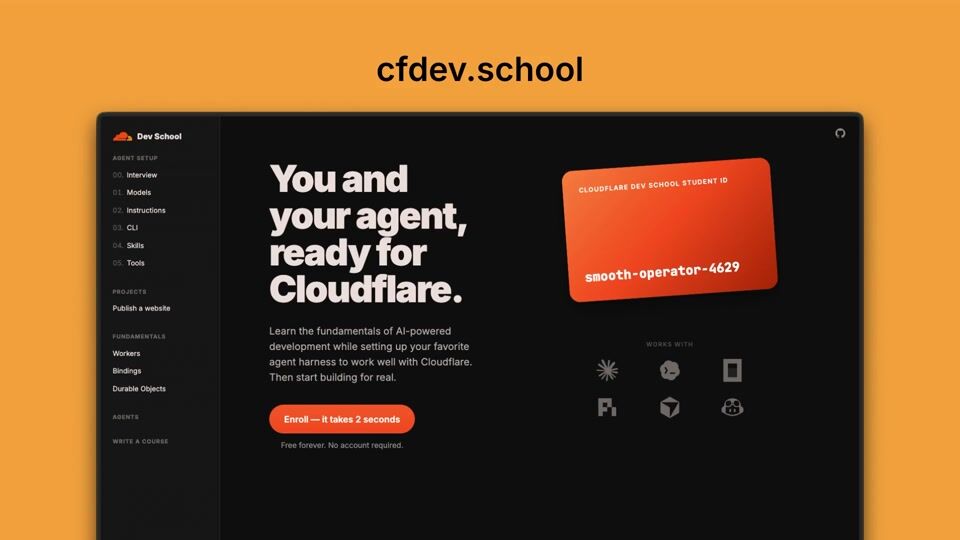
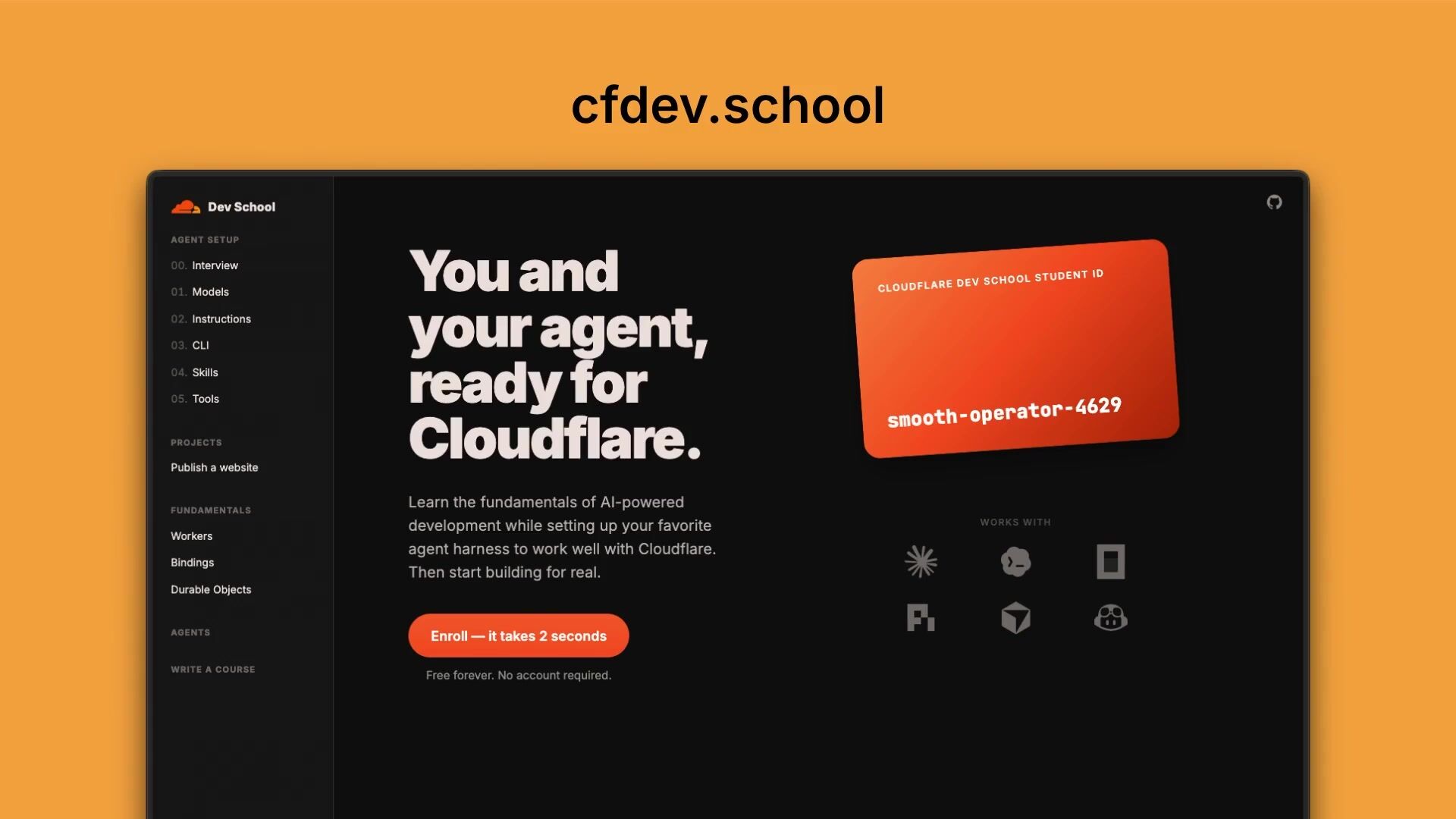
17:02They've been building this, which is CF Dev School, which is a prompt driven way of learning how to make the use of the Cloudflare platform and then how to build on top of it. It coaches you through setting up your agent to be able to integrate. with the skills and the mtp and and tee things up really nicely and then works you through different projects and use cases so you can experiment that and learn at the pace that's good for you at the very top of this experience it actually um conducts a short interview with you to ask you about your level of experience how you like to learn what kind of style of of reinforcement you might like and then it'll tailor the lessons for you and kind of guide you through that step by step i think it's fantastic and I'm looking forward to experimenting with it more. I'd recommend checking it out and kind of giving us some feedback along the way.
17:51It does kind of point out as setting you up how the new CLI is there available to use and it describes that as well which I think is also worth calling out you know the CLI which is generated from you know the API schema at Cloudflare and that allows your agents to also then go and discover the various services around and make use of those in your projects. This is a graceful upgrade. So for anyone who's been using Wrangler before, projects that have Wrangler will continue to use Wrangler, even if you've got this installed and you try and use it this way. But it'll upgrade things and allow you, as you create new projects, to elegantly use the CLI for all of those APIs that are available.
18:38So lots to learn by using that, and this is only going to get better, I think. So it kind of... wrapping up and kind of acknowledging and confessing to my bait and switch that i did earlier on i talked about in the in the blurb for this talk about learning about some of the fundamental primitives available and i guess i did have this slide but really what i thought was going to be much more useful in this session rather than trying to dip into any of these or several of these in just 20 minutes is really to try and suggest that you can get the skills to learn about all of them and the weight do that. You can get the skills, more importantly, to do the thing you're trying to do by using skills and the MCP. I'm kind of thinking that agents really are helping us, teaching us how to fish rather than just giving us a fish. In fact, it does both, I guess. And this is going to build on the fact that while people are saying these days, well, no one reads your documentation anymore. That's what I'm hearing quite a lot. I don't agree with this.
19:34I think documentation continues to be important and in fact agents read them all and so it's lovely having an assistant that is reading everything and consuming it for you. So we're definitely going from a world where learning the primitives before we build is important to learning when to trust and when to question is going to become more important but experimenting and using these tools is a really good way to get stuck into that. So I am out of time but I am keen to hang around and hear from you about how you want to learn and how you want to explore primitives like this and how you want to explore platforms like this and how you want to discover things as well. So you can hear more about this as we put this out on the Cloudflare Dev Twitter account.
20:21That's where a lot of these things will surface as some of these tools become a bit more published and things like the Cloudflare Dev School gains a bit more momentum. So I keep an eye out. for things on there. Thanks for your time.
James Snell
Cloudflare
Alexander Braunreuther, Mark Dembo
Contentful · Cloudflare
Matt Kane
Cloudflare
Be the first to know when registration opens and the agenda goes live.
---
title: "Discovering primitives: Tools you or your agents can use to build the web"
url: "https://www.cloudflare.com/connect/2026/session/discovering-primitives-tools-you-or-your-agents-can-use-to-build-the-web"
year: 2026
---

# Discovering primitives: Tools you or your agents can use to build the web

[Watch session](https://www.cloudflare.com/connect/2026/session/discovering-primitives-tools-you-or-your-agents-can-use-to-build-the-web)

## Session details

- **Track:** Web Performance & Frameworks
- **Topics:** Agentic AI & MCP, App modernization, Cloudflare product innovations
- **Solution areas:** Developer Platform

## About this session

Cloudflare has an ever-expanding set of tools and primitives to power modern web applications, but how do you discover them all and make informed choices about what to use and when? In the age of agentic development, thoughtful technical architecture and software engineering are more important than ever. In this session, explore the Cloudflare product suite and how it’s designed to power even the most demanding of web applications. See some of the fundamental primitives available as well as some of the newer emerging tools. Then, learn how you can guide your agents to further discover the tools available from Cloudflare and make sound decisions about how to leverage this powerful set of web infrastructure products.

## Speakers

- [Phil Hawksworth](https://www.cloudflare.com/connect/speakers/2437005) — Principal Engineer, Developer Adoption, Cloudflare

## Transcript

[0:02] My name is Phil Hawksworth. I work as part of the developer adoption team at Cloudflare. More specifically, I work on education engineering. So a lot's changed recently when it comes to learning and discovery and education for things on the web. So I'm curious to see how we'll get into that. So I must start with a confession. uh which isn't a great way to start let's be honest um i have an agenda for this uh for this session um and i don't mean that i have like a structure that we're going to i do have a structure i do have an agenda but i meant i have uh an ulterior motive um a kind of agenda of my own uh and that is as i say things are changing in education i don't quite know what the right way is to to teach people about technology and about the platforms that we using now.

[0:56] So full transparency, I'm harvesting you. I'm hoping that this conversation, this presentation will provoke some chatter afterwards. I want to hang around afterwards and I want to learn from you a little bit about your experiences learning in this arena now and how you discover and learn things yourself. So this is a horrible expression and I regret it immediately. So I'll take it down. The thing really that I care very deeply about is building the web you know i've been building things on the web for a very long time uh i love it deeply and i think i've really had a lot of satisfaction from every discovery i've made along the way and i think a lot about like the joy of building for the web um hopefully people around the room have been building things on the web have had great satisfaction doing that and discovering things along the way i know that the the web is something that we can use for great joy but also we get great satisfaction from how we build on there ourselves the experience is something that's really important to us.

[1:52] And that's changed a lot, of course, over the last 30 years or so that I've been doing it. Things have certainly changed in that time. But one thing that seems like it's still quite apparent is that mucking about with technology is really gratifying and you can learn a lot. That's how I got into web development. I started messing with the tools that are available to me. And this seems kind of frivolous, and it seems like it's something that we'd- throw in it's not that important and it's just a play thing but play is an incredibly valuable way of learning and discovery and and and learning our craft and experimentation i think we'd probably all agree is is really important and really valuable um for me it started with a tag uh this is the tag oh my sweetheart that i was first got excited about when i was building things on the web i you know i didn't know what i was doing i was mucking around with this stuff and the tag excited me specifically when i learned that i could source an image from somewhere else i could pull someone else's resource from their web server from somewhere across the world into my website and present it to people that was a real moment for me uh that kind of got me excited about the the structure of the web and what that could that could do for me and of course that unpacked into lots more as i learned more than just that one tag you'll be happy to hear as i got to learn more about html and then added css and I started learning Perl when I was trying to build more dynamic things and dynamic experiences on the web and likewise JavaScript.

[3:23] And these building blocks became really important, really powerful. And I love the fact that these building blocks let me do so much. Over time, as we kind of go beyond those building blocks and we get a bit more opinionated and do more, we kind of start to get into different architectures and how we structure and deliver different experiences over the web. more we learn different architectures and the more experiences we get, I think we become much more opinionated. And that's a great thing, becoming opinionated about how we deliver things is important. The tooling and the products that have been available to us now over the course of this evolution of the web have just expanded massively. And we've heard the term primitives around from so many different talks over the course of this event. Lots of different providers, lots of different vendors have got primitives of their own.

[4:12] they're building things, providing to help us build things on. And these building blocks are becoming more and more exciting, more and more powerful, more capable. And that's really enticing to me. The truth is, though, that often people kind of pick a lane, they find something that they're comfortable with, they enjoy it, and they stick with that. And they use that architecture on that set of tools for everything. And you know, once you've got a hammer, sometimes becomes it looks like a bit like a nail and that has caused me some anxiety in the past you know I've been guilty of it myself I've been trying to stretch the same architecture to do all kinds of things that it's not necessarily fit for but one thing that I do kind of find myself coming back to over and over again is that I really care about trying to find the smallest and the simplest primitive or building block or tool to build with I like reducing complexity I like reducing the blast radius of things if they if they go wrong. So I really appreciate kind of well encapsulated primitives or blocks.

[5:08] Which brings me to the state of the Cloudflare developer platform, which is just kind of thriving with all of these different primitives. It's a bit scary to me to think about how to talk about all of these. I don't know what we should talk about today. I don't know if we should talk about workers. That seems like something that would be pretty valuable to dig into or probably more more likely we should talk about uh um durable objects you know an extension of workers and the fact that they can you know they embed an sql database and you can do so much more with them that feels like we should probably dig into those if we're going to talk about the primitives here today but then again you know maybe d1 is the thing that we should talk about you know having serverless uh sql kind of globe with global read replication and various other data utilities bait on top of the these other primitives that that kind of makes working with data kind of effective but you know kv is also you know uh an important primitive that we should we should spend time on or maybe it should be uh something uh something else there's so many things that we could potentially talk about i don't really know where to begin um so when we think about the building blocks of our applications that are there and available to us they're lovely and they're presented so tidily and they're well encapsulated and all of those things but until we really know what we're doing that can feel like a bit of a It can feel a little bit overwhelming, I've found.

[6:36] And there's choice paralysis that can creep in, particularly when we're trying to figure out how we learn all of those things, and before that, how we discover them. How many people here are familiar with the developer platform dashboard at Cloudflare? I'm just kind of curious. I suspected the majority of hands would go up in the room. I know that this over its... life has had some criticism. It's been a tough thing to make elegant and make effective. It's really transformed, I think, in the last year or so. I think it's really wonderful now. And I think it was a little bit difficult to navigate once upon a time. It's forever improving. And yes, you can find a bunch of these primitives in there. But I don't know if it's the best tool for making an informed decision, you know, about which thing to use. It's not really for that.

[7:23] And yet people use that as their way of discovering things and making informed decisions is kind of key for us you know i think there's a message that well if you're going to build things on a platform you just learn the platform but when the platform's so big and the number of premises is so large how do we do that you know i feel like the landscape across the web and you know and even here just within within cloudflare is kind of expanding faster than we can we can learn it so it's a it's a real challenge i was Talking to someone who mentioned just downstairs yesterday how they religiously watch the changelog, which is a great bit of advice. This is a screenshot I took with a very fast shutter speed, so it didn't have motion blur as it was going past, because things get published on there very, very quickly.

[8:14] The person I was chatting to downstairs mentioned that they have a Slack bot at their company that just subscribes to the RSS, so they're always kind of monitoring this and keeping up to date that way. I don't know. I don't know if... this is the best way for us but you know we I don't know if we can understand every new primitive as they come out come out or indeed should we and this is kind of what I'm trying to provoke really in conversation perhaps after this should we understand each new primitive that we're going to be building on or maybe a better question is when should we try and understand each new primitive the thing that has been a challenge presented to me more and more in the realms of kind of education engineering is that people don't necessarily need know these things anymore because of the abstractions that sit on top of them. I am a big fan of people developing really good technical taste. I like to look for that in people that I work with.

[9:03] And I don't know if you can cultivate that if you don't understand the primitives. I'm not sure. I'm really torn about this. I'm looking forward to getting into some arguments about it. But the things that I think are definitely important are experience, because that's where knowledge. becomes wisdom. It's one thing to know what all the primitives are, but the wisdom to know how to use them and when to use them is kind of important. And experience is one of these things that over time, what we're really doing, I guess, is we're accruing skills. That's what's happening over the course of our careers and through that experience. And so it's fairly predictable, of course, that I would go from this to this. This is where I was heading all along.

[9:49] wonderful now that we've got these opportunities to imbue our development environments and our agents with the skills to use the tools effectively and i think we we're all familiar with those now but i don't know how well cloudflare really shouts about the skills that we've cultivated and we've we've curated um and so those are available here on in this repo and of course you can install those in the usual kind of now familiar to many of us way with this command to bring those into your agents so the agents then have insight into how to use all of the various Cloudflare primitives, products, tools, and services. If you're willing to be a little bit more verbose, this will kind of, with a single command, unpack all of those skills, install all of them, make them available for all of your agents kind of globally around your system.

[10:36] And when you do something like that for this number of skills or indeed any of the skills that we're seeing being becoming very popular in web development there's a real kind of feeling of suddenly having this massive wealth of knowledge that you didn't have before this slide originally had a picture behind it uh but not so much for the uh for the rights uh on that when it's a movie clip so now i'm very conscious that this looks like i'm claiming that i know kung fu and i do not or that the previous commands would let you know kung fu it does not uh but this feeling of suddenly having this incredible wealth of knowledge is really wonderful. But it's not just about using these skills then to build.

[11:21] We can also use them to learn. We can use them to inform our architectural choices. And I think that's a really critical thing. Still having some control over the architectural choices we make is really, really important. And these can help us do that. We can suggest architectural patterns to you based on the knowledge of the primitives that it's aware of. the use case that you describe to it and of course the best practices that exist around the web at the moment and this is another way that you can you can guide you to you know making the best choice about the suitable primitives that you might be might be using um i love working in this way just to kind of tinker around and explore uh potential architectures i won't kind of read this all out but you know the idea of describing how you might want to or inquire about you know using cloudflare services how you might build a particular thing and then have the result come back like outlining the different primitives that it would choose for you and why and how that architecture stacks together it's an incredible learning tool i'm i can't i'm conscious as well that this starts out in its response durable objects are the core piece um i'm hearing that a lot around uh the day i don't know it sounds very much like sonil is making that claim himself I'm sure I've heard those exact words from him as the world's biggest durable objects fan, he mentions.

[12:44] But the most important thing is that this is explaining the reasoning, right? This is explaining the reasoning for why we might choose the different primitives and why we might choose a particular architecture. And I think that's huge for discovery and for learning. This gets much more powerful, of course, if we enable the Cloudflare MCP as well. It makes it even more real because not only then are we discovering more deeply, but of course we can take... action then and deploy things straight into Cloudflare that way as well. The MCP works across the entire surface of the Cloudflare API, which is massive. If we thought the picture of the different primitives was a bit overwhelming at the top of the talk, knowing that there are around 2 ,000, 2 ,500 rather, API endpoints that this describes and gives you access to, the context of that is a bit overwhelming.

[13:34] And in fact, it would take, you know, a quarter of a million or thereabouts tokens to kind of hold that in context, which rules it out for some models and makes it pretty expensive context-wise. But luckily, you know, it's been architected in such a way that with code mode, as we call it, you know, we abstract that away a little bit so that the MCP can be much more effective and only actually require about 1 ,100 tokens to query across the entire API surface. So this makes things that we're using even more directly connected to the products um and i think this is a great way that it it helps us use these tools without having to understand them completely first of all you know that this abstraction i was very uncomfortable with as someone who's been building things on the web with my with my meat hands uh you know for for many many years knowing now that everybody can build things with this this kind of abstraction um is kind of exciting to me but a little bit uncomfortable as well.

[14:32] The fact that, you know, builders no longer really need to understand all the primitives. Of course, being informed is always valuable and that's always going to become more and more valuable. But agents, I guess my thesis here really is that agents are just changing how we learn the platform, not only how we build. This isn't new, okay? This idea of learning by doing isn't new, but it's... been more important or more true, I think. We could easily be using these tools just to build and not inspect that and not learn. So we need to kind of pay attention as we're using these things if we really want to learn by doing. We could otherwise just do for the sake of doing's sake, and we don't necessarily learn very much. And for some things, that's absolutely fine. But if we want to learn, we need to be paying attention and using the tools in a very, very thoughtful way.

[15:24] I really like the fact that we can now ask for an outcome rather than having to specify the implementation up front. I do both if I'm very honest. I found that you know over time I'm becoming more opinionated about the way I want things to happen so I do describe that as well. But I like the fact that we can kind of move from you know needing to have this knowledge up front and saying okay add a worker in a queue which hands off to Cloudflare image for batch transformations. That might miss something along the way that we hadn't thought of. Whereas if we're thinking about the outcome that we're trying to achieve instead and asking to allow multiple image uploads for batch transformation and notify the user when ready, that's a very different prospect. When we can let the skills then mop up the gaps that we might have missed in terms of choosing the right primitives, we need to let the user know when things are ready there.

[16:13] So maybe a durable object might be very handy in that scenario that we hadn't described before because of its ability to kind of suspend and resume. web sockets and what have you so we can and i think we should get opinionated once informed but we can use these tools to become informed in the first place being inquisitive always has paid off and i think it's continuing to do so um it was the case before when we were just playing and i think we can be even more inquisitive and experiment and touch and try these tools in a very very real way now and that kind of brings me to something that were some of my colleagues in the education engineering team, I was gonna say launch, but I think revealed is probably a better way of saying this in one of their sessions today and indeed yesterday.

[17:02] They've been building this, which is CF Dev School, which is a prompt driven way of learning how to make the use of the Cloudflare platform and then how to build on top of it. It coaches you through setting up your agent to be able to integrate. with the skills and the mtp and and tee things up really nicely and then works you through different projects and use cases so you can experiment that and learn at the pace that's good for you at the very top of this experience it actually um conducts a short interview with you to ask you about your level of experience how you like to learn what kind of style of of reinforcement you might like and then it'll tailor the lessons for you and kind of guide you through that step by step i think it's fantastic and I'm looking forward to experimenting with it more. I'd recommend checking it out and kind of giving us some feedback along the way.

[17:51] It does kind of point out as setting you up how the new CLI is there available to use and it describes that as well which I think is also worth calling out you know the CLI which is generated from you know the API schema at Cloudflare and that allows your agents to also then go and discover the various services around and make use of those in your projects. This is a graceful upgrade. So for anyone who's been using Wrangler before, projects that have Wrangler will continue to use Wrangler, even if you've got this installed and you try and use it this way. But it'll upgrade things and allow you, as you create new projects, to elegantly use the CLI for all of those APIs that are available.

[18:38] So lots to learn by using that, and this is only going to get better, I think. So it kind of... wrapping up and kind of acknowledging and confessing to my bait and switch that i did earlier on i talked about in the in the blurb for this talk about learning about some of the fundamental primitives available and i guess i did have this slide but really what i thought was going to be much more useful in this session rather than trying to dip into any of these or several of these in just 20 minutes is really to try and suggest that you can get the skills to learn about all of them and the weight do that. You can get the skills, more importantly, to do the thing you're trying to do by using skills and the MCP. I'm kind of thinking that agents really are helping us, teaching us how to fish rather than just giving us a fish. In fact, it does both, I guess. And this is going to build on the fact that while people are saying these days, well, no one reads your documentation anymore. That's what I'm hearing quite a lot. I don't agree with this.

[19:34] I think documentation continues to be important and in fact agents read them all and so it's lovely having an assistant that is reading everything and consuming it for you. So we're definitely going from a world where learning the primitives before we build is important to learning when to trust and when to question is going to become more important but experimenting and using these tools is a really good way to get stuck into that. So I am out of time but I am keen to hang around and hear from you about how you want to learn and how you want to explore primitives like this and how you want to explore platforms like this and how you want to discover things as well. So you can hear more about this as we put this out on the Cloudflare Dev Twitter account.

[20:21] That's where a lot of these things will surface as some of these tools become a bit more published and things like the Cloudflare Dev School gains a bit more momentum. So I keep an eye out. for things on there. Thanks for your time.

## Related sessions

- [A runtime for developers and their agents](https://www.cloudflare.com/connect/2026/session/a-runtime-for-developers-and-their-agents)
- [100 billion profiles, one early bet on Cloudflare Durable Objects](https://www.cloudflare.com/connect/2026/session/100-billion-profiles-one-early-bet-on-cloudflare-durable-objects)
- [EmDash: The secure WordPress successor for humans and agents](https://www.cloudflare.com/connect/2026/session/emdash-the-secure-wordpress-successor-for-humans-and-agents)

## More from Connect

- [All sessions](https://www.cloudflare.com/connect/)
- [Get notified for Connect 2027](https://www.cloudflare.com/connect#2027)


