Secure AI
Cloudflare OS: Automating work with agents connected to your systems


Dan Carter, Phillip Jones
Cloudflare
0:02My name is Sam. I'm Cloudflare CIO, and I spent a long time before that building and leading our enterprise security products, the Cloudflare One Suite. But I've spent all of my time, in particular in the last year, pretty obsessed with this one central challenge. How do we equip and enable everybody in Cloudflare to build and use AI safely without causing security? incidents that would not allow any of us to take naps or really sleep ever, which is really the genesis of Cloudflare OS. And I talked about this a little bit at the keynote. So for those of you who were, I was the very last presenter, they saved the words for last. So for those of you who stuck it out, you might have seen me talk about a little of this, but what I really want to do here is have something more akin to a conversation and a discussion around equipping.
0:56and enabling people with these tools. So I'll go through a very quick history of Cloudflare OS, what it does, and then we'll leave some time for questions because I really would much prefer to understand what you're interested in and where you have thoughts or ideas or places that we could be helping. Because again, this was a tool we built for ourselves and then we started to show it to friends and customers and everybody said, I want that, give me that, I want that optionality, I want that ability to build. and we have now since made it broadly available.
1:29Is anyone here Kyle Kotter, by the way? No? Okay. Good, he's out to get me. It's the one I'm supposed to see after the session. So what we wound up doing with Cloudflare OS really stems from three conversations that I had back in January in our Austin, Texas office. In each of these three conversations, somebody in Cloudflare was coming up to me with what was potentially a real security nightmare, but at best, maybe just a giant token bonfire. The first conversation was someone from our go -to -market team who came up to me and said, Sam, I have transformed go -to -market. I have vibe -coded this app. It is going to completely change the way that we sell Cloudflare and engage.
2:20with customers. It's the greatest thing that's ever been made. All I need are 12 API keys. And by the way, can you teach me how to deploy an application? And I thought, oh no. The second conversation I had was a member of our accounting team who came to me and said, Sam, I've started using AI. It's amazing. And at the time we were making open code available kind of loosely inside the organization against the usage APIs of the different models. including the ones that are running on our own infrastructure and this person from the accounting team said I've built this workflow that helps me reconcile these CSVs this data these various data sets it's just one big skill file and I run it every time and it says it's using hundreds of thousands of tokens is that a problem you know of course this is something that is a really good use case for purely deterministic software not realizing this person was not realizing that what they were in effect doing was each of these just cold start sessions they were lighting tokens on fire to basically rebuild the same script that they were running every morning which is problematic for many reasons and i thought oh no um the third person came up to me and said sam started to use these tools it got me in a lot of trouble because i had built this presentation for our customers and it started saying that cloudflare is also a neobank are we a neobank And I thought, oh no.
3:46And so really the core set of challenges we wanted to address with something like Cloudflare OS is on that first challenge, we need to give people a place to build tools and automation that safely interact with systems of record and keep screens online, which is a thing that I'm not good at,
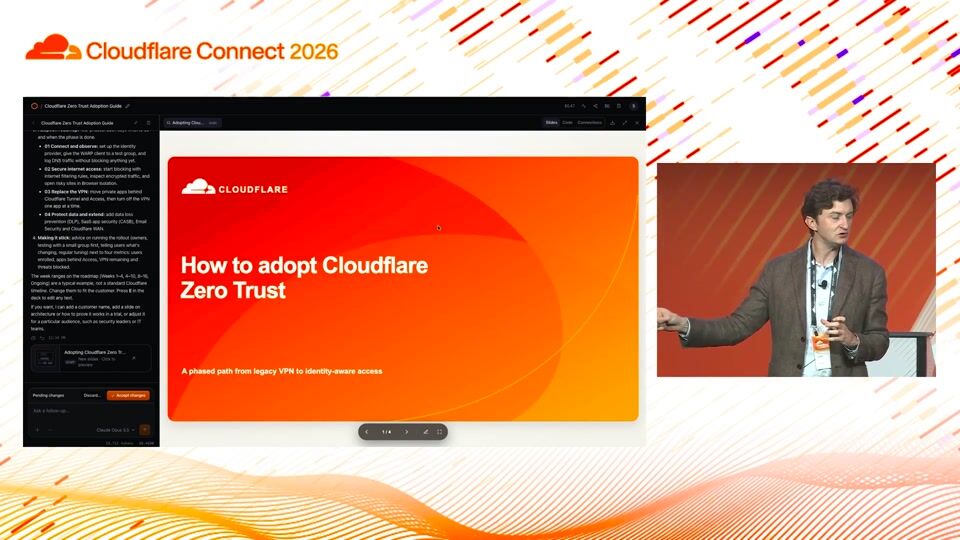
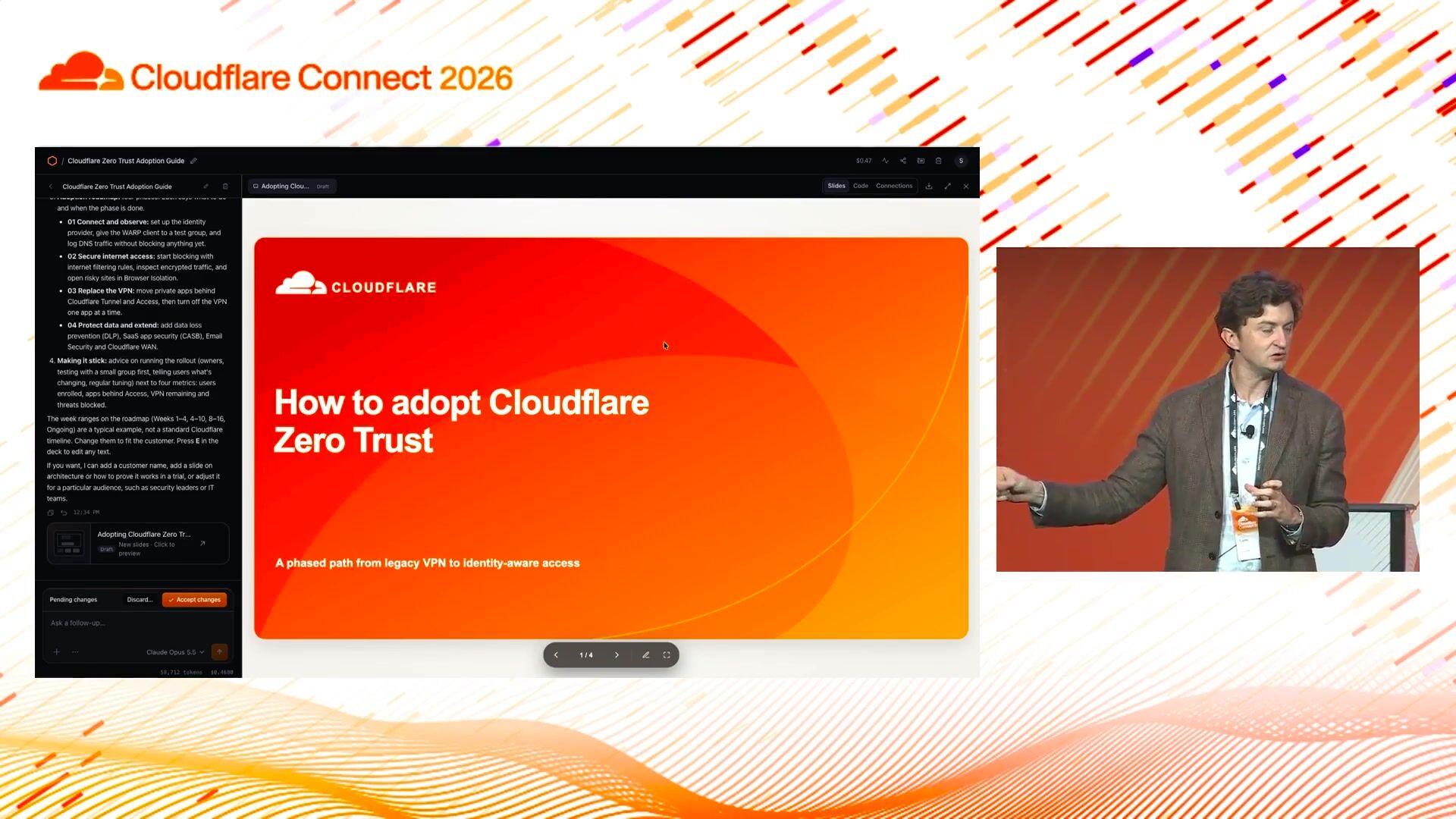
4:00without handing out API keys. We really needed a way for people to be able to build deterministic software or mostly deterministic software with a little bit of AI that hit the actual systems of record that we use. The second use... case is we wanted people to be able to use AI to create automations in workflows that maybe used a little bit of inference here and there, but were mostly consistent and deterministic and could be audited and observed as they executed, which would ultimately reduce the token burn. And the third use case is we needed to ground it in our own context player. And so what we started doing with Koffler OS that you'll see here on the screen is giving everybody a workspace where they can come in and not just create slides and other assets but where and if you'll see this it's all just code it what it's doing is it's writing the code to create the slide deck including the content it's pulling the content itself on this sidebar from our own context library so we spend a lot of time really investing in what makes Cloudflare Cloudflare what are the skill files we need what is the definitive canonical material we needed to find in Cloudflare, and this is all surfaced and available inside of Cloudflare OS for any session.
5:17Likewise, what we wanted to do was think about how can people build tools and applications that use and safely interact with the APIs of our systems of record, again, while avoiding two things. One, avoiding handing out API keys, but two, there are certain actions that we don't just want everybody in Cloudflare to be able to do, right? I don't necessarily want any employee to be able to bulk delete JIRA tickets or send emails autonomously at a certain rate limit or beyond a certain rate limit, right? It's probably never a good thing if multiple people in the company are sending hundreds of emails in the course of a couple of minutes. So within this connector concept, it's kind of a strange hybrid between an MCP server.
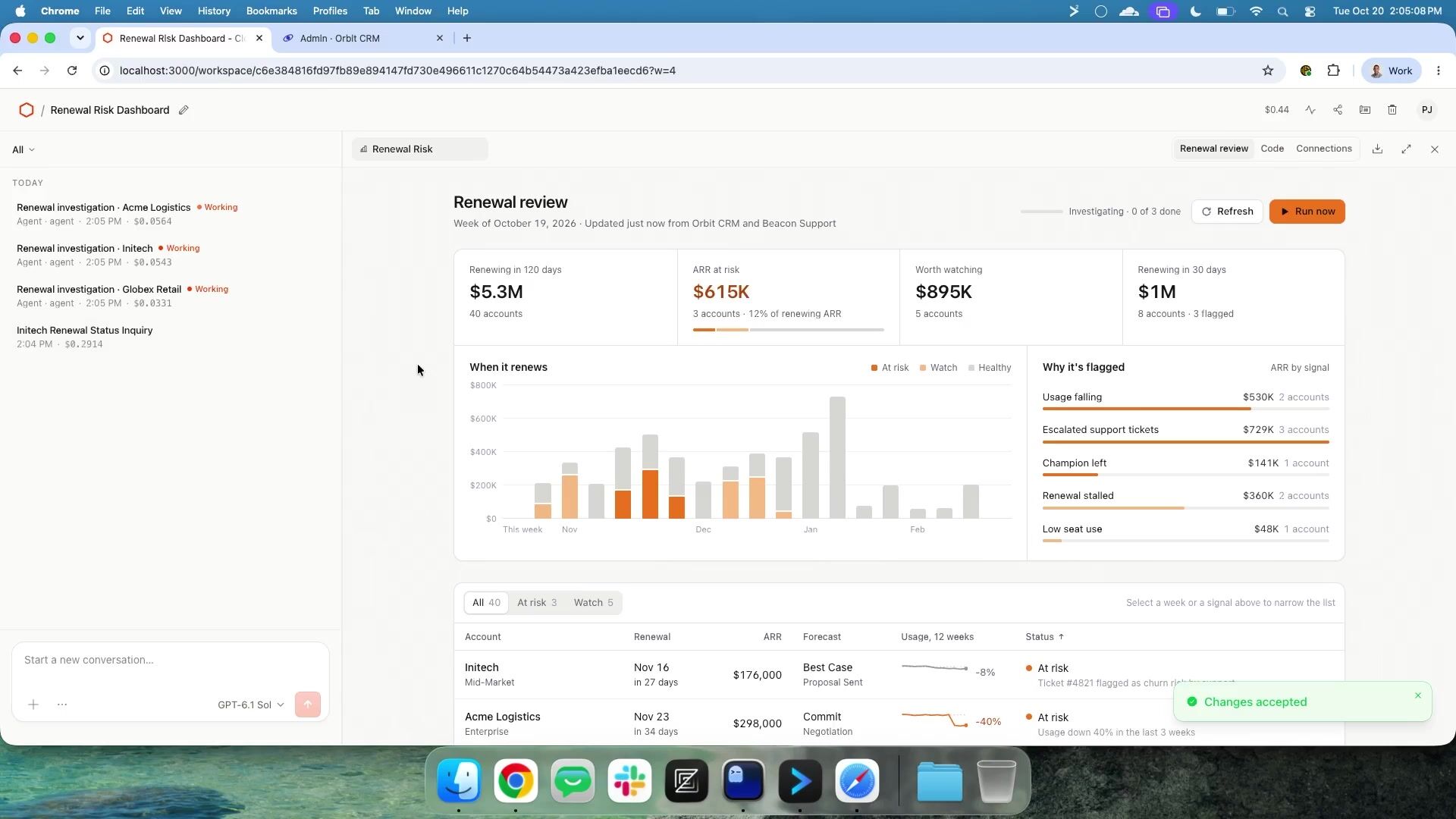
6:04and just a traditional API call, what it introduces is a layer of control over how I connect to these systems and how the applications I build interact. So for a lot of our salespeople, Cloudflare OS is now their primary interface that they use Salesforce. Because if you've ever talked to a salesperson, they have opinions about the Salesforce UI UX. And what they've done and what they can do is come into this ecosystem and build the dashboard. and workflow they always wanted, and it can pull from Salesforce and their email and Iron Cloud where we manage contracts, and they can create the interface that they never could have convinced the Salesforce team to build, simply because something like the Salesforce UI was meant to be usable for really all use cases, but not necessarily hyper-customized for this one salesperson in this one region, how they went about their sales.
6:59And so when we're rolling out like Cloudflare OS what we really wanted to do is make that experience easy and so when you're using this interface to describe the kind of application or tool that you need you can also of course give it access like a binding to the systems of record from this interface or to what's really interesting AI inference from right here in the session so you're building an application and inside that application or that agent or that workflow you want to use a little bit AI but again you don't want to hand out the API keys to your AI inference which is a really good way of discovering a gigantic bill so what this allows is the ability to embed to build applications that actually live as code and get run inside of a durable object that are embedded with system of record access and potentially AI inference and the building of the application itself or the interacting with this session you'll see here If your eyesight's bad like mine, maybe you won't see.
7:59But what you're seeing here is a list of models, both workers' AI models and frontier models that are available in the session. And this is just using Cloudflare's AI gateway. And inside of that AI gateway, you can also control who can see what models. You can set budgets. You can set alerts. You can do dynamic routing based on the use case so that the user does not have to come in and pick a given model. It just gives everybody a level of control that's missing. in a lot of other ecosystems and maybe just as important, a level of optionality that you're not gonna get from some of the other harnesses out there which are more locked into a particular model provider or model ecosystem. So while this builds, one thing I wanna talk about is how we roll this out inside of Cloudflare because I think the technology is there.
8:49I think you could use something like Cloudflare OS to essentially automate. the vast majority of what we do. I think models like Opus 5 .5, concept technologies like durable objects, the ability for gatekeepers to hit systems of record, this is something that is really comprehensive and really robust. What is missing? And I think what's missing is that, like a lot of things, in general, all problems are people-shaped. And I don't mean to say people are the problem here. I mean to say there's a real difficulty sometimes, and I think everyone here has probably observed this, certainly myself, in my own work, in rethinking. thinking what the job is and what the work to be done is. And so the way that we went about this inside of Cloudflare is we told kind of a little white lie. We told everyone at Cloudflare, as we were beginning to roll out Cloudflare OS, hey, there is this magic email alias.
9:39It will do your homework for you. It's AI, right? Send the work you don't want to do to this magic email alias and it will respond and do your homework. And the reason we set it up... way is that vibe coding is way too much fun people really like to vibe code you've probably all seen somebody do a demo and they're like i spent two hundred dollars of tokens and many hours building this and look how cool it is and you're like yeah it looks cool what does it do and they're like i don't know um but it's really fun yeah right uh on on the plane ride over here uh i'm visiting for our lisbon portugal office uh i was you know building something and by the time the plane landed i'm like godly that was a waste of time but it was it was actually kind of fun. But I think that happens. Vibe coding is too much fun. But you know what you don't want to send to a magic email alias? Vibe coding projects. Because again, they're kind of fun. You send to the magic email alias the work you don't want to do, especially if you think it's a bot.
10:32And what we were really doing was we were having two or three people staff this email alias using AI to do the homework for other people, which on a human level is kind of difficult because people are really mean to bots. Like you're pretending you're a bot responding and the person would reply back and be like, you're a dumbass. And I'm like, oh, there's a real human behind this. But in general, what it allowed us to do is really scope out what is the actual work at Cloudflare that we want to automate, that we want to invest in. And we did this for hundreds and thousands of sessions. And so when we rolled out Cloudflare OS, we shipped it with blueprints. And I'll show you what that looks like here. Blueprints and... where people can come in, in this demo instance, we'll see what blueprints are here, and explore essentially code that was already written and available to them.
11:26And as an administrator, you can curate this, you can fork these. They come preloaded with certain connectors to those systems of record, those gatekeepers, and it gives you an opportunity to come in and explore what it looks like. to have kind of an inventory of the agents, the applications, the tools that would come in and make it easy to begin automating work, which was really powerful for us as a way to get people started. We'll go back to this application that's getting built. With using AI, not as just a fun toy to Vibecode things, but as a, oh, I can see how this can impact or address the jobs to be done in my own. role in the kind of thing that I'm trying to do here.
12:14And we've rolled it out that way to the organization. But in general, we started showing this to customers, to friends of ours, like I mentioned earlier. And a lot of people said, wait, I want that too, because we're struggling with some of the same things. And so what we decided to do was maybe a little unusual. We wound up open sourcing this. So this was about a month ago. If you go to GitHub Cloudflare OS, it's an open source project. And the reason we did it that way is because we want anybody and you can use AI, of course, to do this. We want anybody to take this and make it their own because everybody's organization is a little bit different, right? Maybe you want the look and feel of this to be a little bit more specific for your users and your audience. Maybe your users and your audience feel less comfortable kind of thinking about this as code and they want something that's a little bit more one click, or maybe your users and audience more developers right and you want to tailor this to their workflows maybe you want to hide different parts of this like the cost button I don't know you can in that open source project the other reason that we did that is that we really love it if people want to build their own versions of this just using this as inspiration we've seen some customers already do that and that's great because again this is something we're all trying to figure out together I think this is probably the only thing we've ever showed at Cloudflare that literally uses every single technology at Cloudflare and And that's been both fun for us, but also hopefully something that is eye-opening about what the full platform can do.
13:40And because it's an open source project, you can either take it as is or decide, I really like the way these pieces work together. I want to use those and incorporate those into my own workflow. But what about where this is going next? What we're focused on a lot right now is how do we run agents on... autonomously with certain what actions what certain workflows need a human in the loop and what don't and that's been a much more difficult thing than than I think we first realized there's all sorts of native ways inside of Cloudflare OS that with those gatekeepers you can control things like actions that do require a manual human approval or workflows that are actions that are rate limited or certain systems that are more sensitive than others what we're still trying to figure out is what does the interface look like for somebody who does not have a technical background necessarily to come in and describe a more autonomous agent?
14:41I think a lot of people feel really comfortable describing the application or tool they want that would be driven by a human because, again, they've all used software before. I think what's much more difficult is helping people kind of mentally construct what a more autonomous agent is. agent looks like and how to speak that into existence. So we're spending a lot of time on that particular challenge. But again, because it's an open source project, we continue to introduce features and things that we think are genuine improvements. But everybody's challenge in this room is going to be a little bit different, which means you can also take the project and use it to address challenges specific to your organization as well. I love this. I think this is the most fun I've ever had at Cloudflare, getting to see what people can do with this kind of technology, and it's also fun to get to use all of Cloudflare.
15:30But thank you so much for being here.
Dan Carter, Phillip Jones
Cloudflare
Rohin Lohe, Will Papper
Cloudflare
Nikita Cano
Cloudflare
Be the first to know when registration opens and the agenda goes live.
---
title: "Transforming enterprise productivity with Cloudflare OS"
url: "https://www.cloudflare.com/connect/2026/session/transforming-enterprise-productivity-with-cloudflare-os"
year: 2026
---

# Transforming enterprise productivity with Cloudflare OS

[Watch session](https://www.cloudflare.com/connect/2026/session/transforming-enterprise-productivity-with-cloudflare-os)

## Session details

- **Track:** Secure AI
- **Topics:** Agentic AI & MCP, Agentic ROI, Cloudflare product innovations

## About this session

Designed for IT leaders and business executives, this session explores how Cloudflare deploys AI internally to drive operational efficiency. Many organizations struggle to integrate AI tools safely without exposing sensitive database perimeters or creating fragmented workflows. Learn how Cloudflare serves as its own most demanding customer through Cloudflare OS, a secure agentic workspace. Discover how we equip employees with automated agent harnesses, secure system-of-record access, and tools like AI-driven sales assistants to streamline the entire customer lifecycle.

## Speakers

- [Samuel Rhea](https://www.cloudflare.com/connect/speakers/2457284) — Chief Information Officer, Cloudflare

## Transcript

[0:02] My name is Sam. I'm Cloudflare CIO, and I spent a long time before that building and leading our enterprise security products, the Cloudflare One Suite. But I've spent all of my time, in particular in the last year, pretty obsessed with this one central challenge. How do we equip and enable everybody in Cloudflare to build and use AI safely without causing security? incidents that would not allow any of us to take naps or really sleep ever, which is really the genesis of Cloudflare OS. And I talked about this a little bit at the keynote. So for those of you who were, I was the very last presenter, they saved the words for last. So for those of you who stuck it out, you might have seen me talk about a little of this, but what I really want to do here is have something more akin to a conversation and a discussion around equipping.

[0:56] and enabling people with these tools. So I'll go through a very quick history of Cloudflare OS, what it does, and then we'll leave some time for questions because I really would much prefer to understand what you're interested in and where you have thoughts or ideas or places that we could be helping. Because again, this was a tool we built for ourselves and then we started to show it to friends and customers and everybody said, I want that, give me that, I want that optionality, I want that ability to build. and we have now since made it broadly available.

[1:29] Is anyone here Kyle Kotter, by the way? No? Okay. Good, he's out to get me. It's the one I'm supposed to see after the session. So what we wound up doing with Cloudflare OS really stems from three conversations that I had back in January in our Austin, Texas office. In each of these three conversations, somebody in Cloudflare was coming up to me with what was potentially a real security nightmare, but at best, maybe just a giant token bonfire. The first conversation was someone from our go -to -market team who came up to me and said, Sam, I have transformed go -to -market. I have vibe -coded this app. It is going to completely change the way that we sell Cloudflare and engage.

[2:20] with customers. It's the greatest thing that's ever been made. All I need are 12 API keys. And by the way, can you teach me how to deploy an application? And I thought, oh no. The second conversation I had was a member of our accounting team who came to me and said, Sam, I've started using AI. It's amazing. And at the time we were making open code available kind of loosely inside the organization against the usage APIs of the different models. including the ones that are running on our own infrastructure and this person from the accounting team said I've built this workflow that helps me reconcile these CSVs this data these various data sets it's just one big skill file and I run it every time and it says it's using hundreds of thousands of tokens is that a problem you know of course this is something that is a really good use case for purely deterministic software not realizing this person was not realizing that what they were in effect doing was each of these just cold start sessions they were lighting tokens on fire to basically rebuild the same script that they were running every morning which is problematic for many reasons and i thought oh no um the third person came up to me and said sam started to use these tools it got me in a lot of trouble because i had built this presentation for our customers and it started saying that cloudflare is also a neobank are we a neobank And I thought, oh no.

[3:46] And so really the core set of challenges we wanted to address with something like Cloudflare OS is on that first challenge, we need to give people a place to build tools and automation that safely interact with systems of record and keep screens online, which is a thing that I'm not good at,

[4:00] without handing out API keys. We really needed a way for people to be able to build deterministic software or mostly deterministic software with a little bit of AI that hit the actual systems of record that we use. The second use... case is we wanted people to be able to use AI to create automations in workflows that maybe used a little bit of inference here and there, but were mostly consistent and deterministic and could be audited and observed as they executed, which would ultimately reduce the token burn. And the third use case is we needed to ground it in our own context player. And so what we started doing with Koffler OS that you'll see here on the screen is giving everybody a workspace where they can come in and not just create slides and other assets but where and if you'll see this it's all just code it what it's doing is it's writing the code to create the slide deck including the content it's pulling the content itself on this sidebar from our own context library so we spend a lot of time really investing in what makes Cloudflare Cloudflare what are the skill files we need what is the definitive canonical material we needed to find in Cloudflare, and this is all surfaced and available inside of Cloudflare OS for any session.

[5:17] Likewise, what we wanted to do was think about how can people build tools and applications that use and safely interact with the APIs of our systems of record, again, while avoiding two things. One, avoiding handing out API keys, but two, there are certain actions that we don't just want everybody in Cloudflare to be able to do, right? I don't necessarily want any employee to be able to bulk delete JIRA tickets or send emails autonomously at a certain rate limit or beyond a certain rate limit, right? It's probably never a good thing if multiple people in the company are sending hundreds of emails in the course of a couple of minutes. So within this connector concept, it's kind of a strange hybrid between an MCP server.

[6:04] and just a traditional API call, what it introduces is a layer of control over how I connect to these systems and how the applications I build interact. So for a lot of our salespeople, Cloudflare OS is now their primary interface that they use Salesforce. Because if you've ever talked to a salesperson, they have opinions about the Salesforce UI UX. And what they've done and what they can do is come into this ecosystem and build the dashboard. and workflow they always wanted, and it can pull from Salesforce and their email and Iron Cloud where we manage contracts, and they can create the interface that they never could have convinced the Salesforce team to build, simply because something like the Salesforce UI was meant to be usable for really all use cases, but not necessarily hyper-customized for this one salesperson in this one region, how they went about their sales.

[6:59] And so when we're rolling out like Cloudflare OS what we really wanted to do is make that experience easy and so when you're using this interface to describe the kind of application or tool that you need you can also of course give it access like a binding to the systems of record from this interface or to what's really interesting AI inference from right here in the session so you're building an application and inside that application or that agent or that workflow you want to use a little bit AI but again you don't want to hand out the API keys to your AI inference which is a really good way of discovering a gigantic bill so what this allows is the ability to embed to build applications that actually live as code and get run inside of a durable object that are embedded with system of record access and potentially AI inference and the building of the application itself or the interacting with this session you'll see here If your eyesight's bad like mine, maybe you won't see.

[7:59] But what you're seeing here is a list of models, both workers' AI models and frontier models that are available in the session. And this is just using Cloudflare's AI gateway. And inside of that AI gateway, you can also control who can see what models. You can set budgets. You can set alerts. You can do dynamic routing based on the use case so that the user does not have to come in and pick a given model. It just gives everybody a level of control that's missing. in a lot of other ecosystems and maybe just as important, a level of optionality that you're not gonna get from some of the other harnesses out there which are more locked into a particular model provider or model ecosystem. So while this builds, one thing I wanna talk about is how we roll this out inside of Cloudflare because I think the technology is there.

[8:49] I think you could use something like Cloudflare OS to essentially automate. the vast majority of what we do. I think models like Opus 5 .5, concept technologies like durable objects, the ability for gatekeepers to hit systems of record, this is something that is really comprehensive and really robust. What is missing? And I think what's missing is that, like a lot of things, in general, all problems are people-shaped. And I don't mean to say people are the problem here. I mean to say there's a real difficulty sometimes, and I think everyone here has probably observed this, certainly myself, in my own work, in rethinking. thinking what the job is and what the work to be done is. And so the way that we went about this inside of Cloudflare is we told kind of a little white lie. We told everyone at Cloudflare, as we were beginning to roll out Cloudflare OS, hey, there is this magic email alias.

[9:39] It will do your homework for you. It's AI, right? Send the work you don't want to do to this magic email alias and it will respond and do your homework. And the reason we set it up... way is that vibe coding is way too much fun people really like to vibe code you've probably all seen somebody do a demo and they're like i spent two hundred dollars of tokens and many hours building this and look how cool it is and you're like yeah it looks cool what does it do and they're like i don't know um but it's really fun yeah right uh on on the plane ride over here uh i'm visiting for our lisbon portugal office uh i was you know building something and by the time the plane landed i'm like godly that was a waste of time but it was it was actually kind of fun. But I think that happens. Vibe coding is too much fun. But you know what you don't want to send to a magic email alias? Vibe coding projects. Because again, they're kind of fun. You send to the magic email alias the work you don't want to do, especially if you think it's a bot.

[10:32] And what we were really doing was we were having two or three people staff this email alias using AI to do the homework for other people, which on a human level is kind of difficult because people are really mean to bots. Like you're pretending you're a bot responding and the person would reply back and be like, you're a dumbass. And I'm like, oh, there's a real human behind this. But in general, what it allowed us to do is really scope out what is the actual work at Cloudflare that we want to automate, that we want to invest in. And we did this for hundreds and thousands of sessions. And so when we rolled out Cloudflare OS, we shipped it with blueprints. And I'll show you what that looks like here. Blueprints and... where people can come in, in this demo instance, we'll see what blueprints are here, and explore essentially code that was already written and available to them.

[11:26] And as an administrator, you can curate this, you can fork these. They come preloaded with certain connectors to those systems of record, those gatekeepers, and it gives you an opportunity to come in and explore what it looks like. to have kind of an inventory of the agents, the applications, the tools that would come in and make it easy to begin automating work, which was really powerful for us as a way to get people started. We'll go back to this application that's getting built. With using AI, not as just a fun toy to Vibecode things, but as a, oh, I can see how this can impact or address the jobs to be done in my own. role in the kind of thing that I'm trying to do here.

[12:14] And we've rolled it out that way to the organization. But in general, we started showing this to customers, to friends of ours, like I mentioned earlier. And a lot of people said, wait, I want that too, because we're struggling with some of the same things. And so what we decided to do was maybe a little unusual. We wound up open sourcing this. So this was about a month ago. If you go to GitHub Cloudflare OS, it's an open source project. And the reason we did it that way is because we want anybody and you can use AI, of course, to do this. We want anybody to take this and make it their own because everybody's organization is a little bit different, right? Maybe you want the look and feel of this to be a little bit more specific for your users and your audience. Maybe your users and your audience feel less comfortable kind of thinking about this as code and they want something that's a little bit more one click, or maybe your users and audience more developers right and you want to tailor this to their workflows maybe you want to hide different parts of this like the cost button I don't know you can in that open source project the other reason that we did that is that we really love it if people want to build their own versions of this just using this as inspiration we've seen some customers already do that and that's great because again this is something we're all trying to figure out together I think this is probably the only thing we've ever showed at Cloudflare that literally uses every single technology at Cloudflare and And that's been both fun for us, but also hopefully something that is eye-opening about what the full platform can do.

[13:40] And because it's an open source project, you can either take it as is or decide, I really like the way these pieces work together. I want to use those and incorporate those into my own workflow. But what about where this is going next? What we're focused on a lot right now is how do we run agents on... autonomously with certain what actions what certain workflows need a human in the loop and what don't and that's been a much more difficult thing than than I think we first realized there's all sorts of native ways inside of Cloudflare OS that with those gatekeepers you can control things like actions that do require a manual human approval or workflows that are actions that are rate limited or certain systems that are more sensitive than others what we're still trying to figure out is what does the interface look like for somebody who does not have a technical background necessarily to come in and describe a more autonomous agent?

[14:41] I think a lot of people feel really comfortable describing the application or tool they want that would be driven by a human because, again, they've all used software before. I think what's much more difficult is helping people kind of mentally construct what a more autonomous agent is. agent looks like and how to speak that into existence. So we're spending a lot of time on that particular challenge. But again, because it's an open source project, we continue to introduce features and things that we think are genuine improvements. But everybody's challenge in this room is going to be a little bit different, which means you can also take the project and use it to address challenges specific to your organization as well. I love this. I think this is the most fun I've ever had at Cloudflare, getting to see what people can do with this kind of technology, and it's also fun to get to use all of Cloudflare.

[15:30] But thank you so much for being here.

## Related sessions

- [Cloudflare OS: Automating work with agents connected to your systems](https://www.cloudflare.com/connect/2026/session/cloudflare-os-automating-work-with-agents-connected-to-your-systems)
- [Monetizing AI agent traffic: Write your first Monetization Gateway rule](https://www.cloudflare.com/connect/2026/session/monetizing-ai-agent-traffic-write-your-first-monetization-gateway-rule)
- [The agentic network: Secure private connectivity for agents](https://www.cloudflare.com/connect/2026/session/the-agentic-network-secure-private-connectivity-for-agents)

## More from Connect

- [All sessions](https://www.cloudflare.com/connect/)
- [Get notified for Connect 2027](https://www.cloudflare.com/connect#2027)


